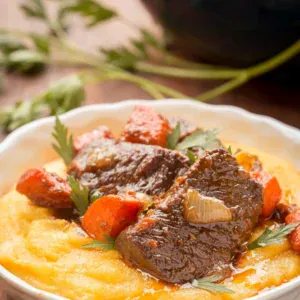
Braised short ribs simmered low and slow with onions, carrots, garlic and a splash of wine, until they fall apart at the touch of a fork.
- 4½ lb boneless beef short ribs about 8 to 9 pieces (Note 1)
- 3 Tbsp olive oil regular, not extra virgin
- 1 large onion peeled and diced
- 2 medium carrots peeled and roughly chopped, divided
- 5 garlic cloves peeled, divided
- 3 cups stock low-sodium beef or chicken, or water; enough to just cover the ribs
- ½-1½ cups red wine (120 to 360 ml), dry, or white wine, or more stock (Note 3)
- 2 tsp kosher salt Morton
- 1 tsp ground black pepper freshly ground
- 2 bay leaves
- 2 tsp mustard seeds whole
-
Pat dry. Pat 4½ lb boneless beef short ribs dry on all sides with paper towels.
-
Heat the pot. Heat a large Dutch oven over medium-high heat until hot all over, then add 3 Tbsp olive oil. (Note 2)
-
Sear in batches. Sear a few ribs at a time for 2 to 3 minutes per side, until deep brown on all sides, turning them with tongs. Don't crowd the pot. Move them to a bowl.
-
Cook the onion. Pour off all but about 2 Tbsp of the fat. Add 1 large onion and cook for 5 to 7 minutes, scraping up the brown bits, until soft and lightly browned.
-
Add half the carrots. Set aside half of the chopped carrots. Add the rest and cook for 3 to 4 minutes. Return the ribs and their juices to the pot.
-
Add the wine and stock. Pour in ½-1½ cups red wine and let it bubble for 2 to 3 minutes, scraping the bottom. Add 3 cups stock, enough to just cover the ribs. (Note 3)
-
Season the liquid. Add 2 tsp kosher salt, 1 tsp ground black pepper, 2 bay leaves, 2 tsp mustard seeds and 3 of the garlic cloves. Stir and taste; it should taste a little saltier than you would want a soup.
-
Simmer covered. Cover and keep at a gentle simmer on low for about 2½ hours. Turn the ribs every 30 minutes and keep them covered with liquid. (Note 4)
-
Finish the carrots. Add the reserved carrots and the last 2 garlic cloves. Cover and cook for about 20 minutes, until the carrots are soft and a fork slides into the meat with no resistance. (Note 5)
-
Skim and serve. Turn off the heat, rest 5 minutes, then skim off the fat and remove the bay leaves. Serve over polenta, mashed potatoes, grits or pasta. (Note 6)
1. Short ribs: I use thick boneless short ribs. English-cut bone-in ribs work too: buy about twice the weight and plan on about 30 minutes more simmering. Flanken-cut ribs are too thin for braising. For a budget version, use beef chuck (see Tips). Beef shrinks to about half its size as it braises, so the raw pieces look bigger than what ends up on the plate.
2. Pot: No Dutch oven? Use any heavy-bottomed pot or deep pan with a lid. A heavy pot holds its heat when the cold meat goes in, so the ribs brown instead of steaming.
3. Wine: Use ½ cup (120 ml) for a light wine flavor, or up to 1½ cups (360 ml) for a deeper, richer sauce. With more wine, use a little less stock so the ribs are just covered. Use a dry wine like Cabernet Sauvignon or Merlot, never salted "cooking wine." White wine works too. To skip wine, use more stock.
4. Liquid and heat: Keep the liquid at small, lazy bubbles; a hard boil makes the meat tough. If the liquid drops below the ribs, add a splash of stock or water. To braise in the oven instead, preheat it to 325°F (165°C) before searing. Bring the pot to a simmer, cover it and move it to the oven for 2½ to 3 hours, turning the ribs once halfway. Start checking at 2½ hours.
5. Doneness: Go by the fork, not the clock. The ribs are done when a fork slides in with no resistance. If they still feel firm, keep simmering and check every 20 minutes.
6. Make-ahead: Cook up to 2 days ahead and refrigerate in the liquid. The fat hardens on top so you can lift it off, and the flavor gets even better overnight.
7. Storage: Refrigerate within 2 hours and use within 3 to 4 days. Freeze in the sauce for up to 3 months and thaw overnight in the fridge. To reheat, warm covered over medium-low heat for 20 to 30 minutes, or in a 325°F (165°C) oven for 30 to 40 minutes, until the center reaches 165°F (74°C). Turn the ribs once instead of stirring.
8. Tips: For a budget version, cut a beef chuck roast into large chunks, trimming off tendons, connective tissue and fat. Brown the ribs to a dark crust on every side. Use low-sodium stock, since the liquid cooks down. Rest the ribs in the covered pot for 15 to 20 minutes before serving if you have time. For a double batch, use a wide pot and sear in more batches.