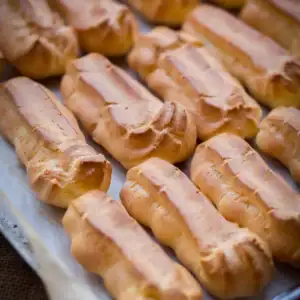
Choux pastry (pate a choux) is the light shell behind eclairs and cream puffs, crisp and golden outside, soft and hollow inside.
Before you start: the tricky parts are drying the dough, adding just enough egg, and piping. The post above walks through each one with photos, the why behind every step, and fixes if something goes wrong.
- 1/2 cup whole milk
- 1/2 cup water
- 1/2 cup unsalted butter
- 1/4 tsp granulated sugar
- 1/4 tsp kosher salt Morton
- 1 cup all-purpose flour
- 5 large eggs whisked; you may not need all of it
- 1 pastry bag large
- 1 French star tip large, such as Ateco 869
-
Heat the oven to 425°F and line 2 baking sheets with parchment paper. An oven thermometer on the middle rack shows the real temperature. Dark nonstick sheets? See Note 1.
-
Whisk the eggs: in a measuring cup with a spout, whisk 5 large eggs just until blended, not foamy, and set them aside.
-
Boil the liquids: in a medium stainless steel saucepan (not nonstick), bring 1/2 cup whole milk, 1/2 cup water, 1/2 cup unsalted butter, 1/4 tsp granulated sugar, and 1/4 tsp kosher salt to a full, rolling boil over high heat, with the butter fully melted. Add the flour the moment it boils.
-
Add the flour: to the boiling liquid, add 1 cup all-purpose flour all at once and stir fast with a wooden spoon until it pulls into a ball. Turn the heat to low and keep stirring for 2 to 3 minutes, until it looks like thick mashed potatoes and a thin film coats the bottom of the pan.
-
Cool the dough: move it to the bowl of a stand mixer and mix on low with the paddle for 2 to 3 minutes, until it feels warm but is no longer steaming, about 125 to 140°F, or cool enough to hold your hand on the bowl for 10 seconds. Do not cool it to room temperature (see post above for why). No stand mixer? See Note 7.
-
Beat in the eggs: with the mixer on low, add the whisked eggs to the dough in 4 to 5 additions, mixing until smooth before each one. Each addition looks slippery and broken at first, then comes back together. Stop when the dough is glossy and falls off the paddle in a thick V, even if some egg is left (Note 2). Then mix 30 seconds more until smooth.
-
Fill the pastry bag: fit 1 pastry bag with 1 French star tip, stand it in a tall glass, and fill it with the dough. Push the dough down to the tip and twist the top closed so there are no air pockets.
-
Pipe the eclairs: onto the lined sheets, pipe 3- to 4-inch logs about 2 inches apart, the same thickness from end to end, holding the bag at a 45° angle with your index finger on the metal tip and your middle finger gliding on the parchment as a guide, and the tip about 1/2 inch above the parchment. Stop squeezing at the end of each log and flick the tip back, then tap down any ends that stick up with a wet finger. For cream puffs, see Note 3. Optional: dust the tops with powdered sugar (Note 10).
-
Chill the second tray in the fridge or freezer while the first one bakes (Note 4).
-
Bake the shells: at 425°F until puffed to about double and the ridges are just turning light golden, about 15 minutes. Lower the oven to 375°F and bake 10 to 15 minutes more, until deep golden even in the creases and the sides look firm and dry. Keep the oven door closed until they are golden, or they will deflate. Soggy inside? See Note 8.
-
Vent the shells (optional, but it helps): right out of the oven, poke 2 holes at each end of every shell with a skewer to let the steam out, and wiggle the skewer inside to break up any inner walls, then cool them on a wire rack (Note 5).
-
Bake the second tray straight from the fridge or freezer once the oven is back at 425°F, with the same times and temperatures.
1. Dark baking sheets: a dark nonstick sheet runs hotter than light aluminum and can brown the bottoms before the shells dry out inside. Drop the oven about 25°F, or stack it on a second sheet.
2. How much egg: the dough is ready when it is glossy and slides off the paddle slowly, leaving a thick V-shaped ribbon hanging. Stop there, even with egg left over. Too much egg makes the shells spread flat, and it cannot be taken back out.
3. Cream puffs: hold the bag straight up, tip about 1/2 inch above the parchment, and pipe 1 1/2-inch mounds about 2 inches apart and smooth the tips with a wet finger. Bake at the same temperatures and start checking at the short end of the time. The batch makes 30 to 40.
4. Freeze unbaked: freeze the piped tray until firm, then move the pieces to a freezer bag for up to 1 month. Bake straight from frozen at 425°F as written.
5. Baked shells: keep unfilled shells airtight at room temperature for 1 day, or freeze them for up to 1 month. Recrisp at 350°F for 5 to 7 minutes and cool before filling.
6. Filling: fill the shells no more than a few hours before serving, and keep filled pastries in the fridge.
7. No stand mixer: with a hand mixer, beat the dough in a large bowl on low for a minute or two to cool it, then add the eggs the same way. By hand, stir with a wooden spoon until it stops steaming, then beat hard after each addition of egg. It looks broken at first and turns smooth as you keep going.
8. Soggy shells: put them back in a 350°F oven for 5 to 10 minutes to dry out, then vent and cool again. Next time, bake until they are deep golden, even in the creases.
9. Gougeres: leave out the sugar. After the last egg, beat in 1 1/2 cups (150 g) finely grated Gruyere, about the same weight as the flour. Pipe 1-inch rounds and bake at the same temperatures, checking at the short end of the time.
10. Powdered sugar dusting (optional): mix 1/2 cup (60 g) powdered sugar with 2 teaspoons cornstarch and sift a thin layer over the piped dough before baking. It gives a crisper, evenly browned shell.