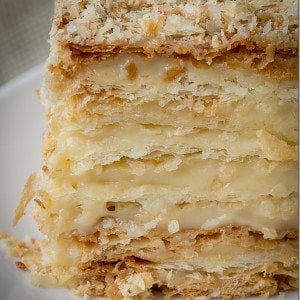
The ultimate Russian Napoleon cake layers of thin puff pastry sheets and a creamy custard filling.
- 1 3/4 cups unsalted butter cold or frozen, cubed
- 2 eggs
- ⅔ cups water cold
- 4.5-6 cups sifted all-purpose flour (1 cup = 150 g)
- 3 tbsp vodka/cognac (replace with water if can not use)
- 2 tbsp white vinegar
- ⅛ tsp kosher salt
- 7 egg yolks
- 6 cups whole milk
- 2 cup granulated sugar
- 1 tbsp vanilla extract
- 2/3 cups all-purpose flour sifted
- 1 ¾ cups unsalted butter
-
Wet ingredients: In a large cup whisk together 2 eggs, ⅛ tsp kosher salt and stir in ⅔ cups water, then add 2 tbsp white vinegar & 3 tbsp vodka/cognac. Set aside.
-
Combine flour & butter: Add 4.5-6 cups sifted all-purpose flour and 1 3/4 cups unsalted butter (cold cubed) to the cup of food processor.
Then, keep pulsing the mixture until the mixture is the size of peas.
-
Add the wet ingredients into the flour-butter mixture and continue pulsing until the dough just starts sticking to itself.
-
Form a dough: Turn out the contents of the food processor bowl onto work surface and press the dough together with your hands, trying to work it as little as possible.
Knead it several times, but as soon as the dough comes together stop kneading/working it. The butter needs to stay in small chunks within the dough or the puff pastry will not have puffy layers.
-
Divide & refrigerate: Cut the dough into 4 equal pieces. Roll each piece into a ball. Flatten it into a disk. Cover with plastic wrap and refrigerate for 1-2 hours (or up to several days if making ahead of time).
This will allow the flour to fully absorb the liquids and the butter to harden again.
-
Egg yolk mixture: In a 6 qt pot, whisk together 7 egg yolks and 2 cup granulated sugar, adding a little bit of milk as needed to help with mixing.
Next, whisk in 2/3 cups all-purpose flour until you have a uniform, lump-free batter adding bits of milk as needed to help with mixing.
-
Hot milk: In a separate sauce pot, heat the remaining 6 cups whole milk over medium heat, whisking continuously to keep the bottom from scorching. Alternatively, microwave the milk until it is boiling.
-
Temper the egg yolk mixture by slowly pouring the hot milk into the egg yolk mixture, all the while mixing.
-
Thicken the custard: Set the mixture over medium heat and bring to a boil over medium heat, whisking continuously (!!) to prevent the bottom of the pot from scorching.
Once boiling, cook for 2-3 minutes, or until the custard thickens and the floury taste dissipates. Take off the heat.
-
Flavor it: Stir in 1 tbsp vanilla extract and 1 ¾ cups unsalted butter until completely melted.
-
Make it smooth: If your custard had clumps, run it through a fine sieve to remove clumps.
-
Allow the custard to cool by pouring it into a rimmed baking sheet and covering it with plastic wrap. The plastic wrap should touch the surface of the custard to keep a skin from forming.
Tip: If making ahead, refrigerate covered for up to 3 days.
-
Prep: Preheat oven to 400°F. Set the rack in the middle.
-
Prep the baking sheet: Set a wet towel under an upside-down 12" x 16" baking sheet (or use a flat cookie sheet, right side up) to prevent it from moving as you'll roll the cake layers on top of it.
-
Roll the cake layers: Take 1 dough ball from the fridge at a time and divide it into 2 equal pieces. Roll each piece into a 12 ½" circle on top of the upside-down baking sheet dusting the surface with flour as needed. The cake layers will be very thin.
Prick with a fork every 1-2 inches all over, to prevent uneven puffing.
-
Bake for 5-7 minutes at 400 or 425F, or until lightly golden, but not deep golden nor pale golden.
TIP: Start a timer every time a cake layer goes in the oven to prevent it from burning. The cake layers bake fast and it is easy to forget and burn them.
If you have two baking sheets, roll your next layer as the previous one is baking.
-
Trim: As soon as the cake layer is baked and out of the oven, place an 11-inch stensil (dinner plate, large lid, etc.) on top of the cake layer and use a very sharp knife or a pizza cutter to cut around it.
Collect the scraps in a separate bowl, and be careful not to let the round cake layers crack. Use a flat cookie sheet to move it.
Repeat steps 3 & 4 with the rest of the dough to achieve 8 layers total.
-
Crush the cake scraps into finer crumbs. Set aside. This will be used to cover the outside of the cake.
-
Divide the custard into 8 equal pieces by "cutting" it with a spatula or a spoon. As the custard cools, it will thicken like a jelly, making it easy to divide.
-
Add a dab of frosting to the serving plate and top it with the first cake layer.
Use a cookie sheet to transfer the cake layers. Press gently to adhere.
-
Surround the cake layer by a cake ring & secure it with a ribbon or a cake strip to keep the ring tight around the cake.
The cake ring is optional, but it does help to keep the edges tidy.
-
Layer the cake: Add 1/8 of the custard (about 1 1/3 cups) to the cake layer inside the cake ring, then spread it evenly.
Continue layering the puff pastry cake and custard inside the ring, gently pressing down on the cake before adding the next layer of custard.
Once you add the 8th/last cake layer, add only half of the remaining frosting and spread it thin.
Reserve the other half of the cake's sides for later.
Cover the top: Sprinkle some of the crushed cake crumbs over the top of the cake to completely cover the surface. The remaining crumbs will be used for the cake's sides later.
The cake crumbs are used to prevent a film from forming on the custard.
-
Remove the ring: Run a thin knife on the inside of the cake ring to loosen the cake from the ring. Remove the ring.
-
Coat the sides:
Use the remaining custard to cover the sides with a thin layer of custard.
Add crushed cake crumbs: Place the cake on a turntable or raised surface with a baking sheet underneath. Using your cupped hand, gently press the crumbs onto the sides, letting any excess fall onto the baking sheet below. If there are any remaining crumbs, sprinkle them on top.
Tap the serving plate with the cake several times allowing any loose crumbs to fall to the sides of the plate. Now clean up the edges of the cake plate and refrigerate the cake covered until ready to eat.
-
See notes for serving suggestions.
Serving Suggestions:
Cake tastes best when the custard is at room temperature.
Crispy version:
Serve immediately after assembly for thin, crisp layers with creamy custard. The cake will stay crispy for about 1–2 hours.
Soft & tender version:
Refrigerate for 24–48 hours, then bring to room temperature before serving. The layers will absorb the custard, becoming soft and easy to slice.
Important:
Avoid serving in between these stages, as the layers will be slightly gummy and harder to cut.