- 1 cup whole milk warm, 90°F to 100°F (32°C to 38°C), divided
- ½ cup granulated sugar divided
- 2 tsp active dry yeast or instant yeast, like Platinum
- 3 cups bread flour 1 cup = 150 g (Note 1); or all-purpose flour
- 1 large egg room temperature
- 1 large egg yolk room temperature
- 2 Tbsp sour cream full-fat
- 1 Tbsp vanilla extract
- 3 oz unsalted butter softened
- ½ tsp kosher salt Morton
- 1 cup dried blueberries soaked and blotted dry
- 1 cup white chocolate chips
- 1 large egg for the egg wash
- 1 pinch kosher salt for the egg wash
- 1 cup powdered sugar optional, for the glaze
- 1½ Tbsp whole milk optional, for the glaze
- ½ tsp vanilla extract optional, for the glaze
-
Proof the yeast: warm ½ cup of the milk to 90°F to 100°F (32°C to 38°C), like warm bath water. Stir in 1 tsp of the sugar and 2 tsp active dry yeast, and let it sit about 10 minutes, or until it foams up. A tall, fluffy foam means strong yeast (Note 2).
-
Combine the dough: in the bowl of a stand mixer, add 3 cups bread flour, the rest of the sugar, the remaining ½ cup warm milk, 1 large egg, 1 large egg yolk, 2 Tbsp sour cream, 1 Tbsp vanilla extract and the yeast mixture. Mix with the dough hook until a rough, shaggy dough forms.
-
Knead the dough: knead on low (speed 2 to 3) for about 20 minutes, until the dough stops sticking to the sides of the bowl, feels elastic and passes the windowpane test (Note 3). Stop once it is elastic, since over-kneaded dough tears and cannot hold a good rise.
-
Add the butter and salt: add 3 oz unsalted butter and ½ tsp kosher salt and knead 5-7 minutes, until no streaks of butter remain. Tearing the dough into chunks helps the butter mix in faster.
-
Let the dough rise: shape the dough into a smooth ball by tucking the edges under. Set it in a large oiled bowl, cover loosely and let it rise somewhere warm and draft-free, about 80°F (27°C), until doubled, about 1½ hours. If it more than doubles, punch it down and keep going (Note 4).
-
Soak the blueberries: while the dough rises, cover 1 cup dried blueberries with warm water for about 10 minutes. Drain them and blot them dry with paper towels.
-
Punch down the dough: press the air out gently and turn it out onto a well-oiled counter.
-
Roll out the dough: roll the dough into a 24 x 12-inch rectangle. Roll gently so you keep the air bubbles.
-
Fill the dough: scatter 1 cup dried blueberries and 1 cup white chocolate chips over it, leaving a 1-inch strip bare along one long edge. Press them in lightly.
-
Roll it up: roll the dough up tightly like a jelly roll, with no air gaps. Pinch the seam shut and let it rest seam side down for 5 minutes.
-
Stretch the roll: place both hands in the middle and roll it back and forth while moving your hands out toward the ends, until it is twice as long and half as thick.
-
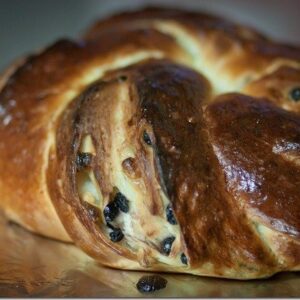
Twist into a wreath: fold the rope into a V and twist the two strands around each other, starting at the fold. Tuck the loose ends into the loop and pinch to close the ring.
-
Let the wreath rise: set the wreath on a baking sheet lined with parchment paper, cover loosely with a towel and let it rise until almost doubled, about 1 hour. With the filling in, it can take longer (Note 4).
-
Heat the oven: about 20 minutes into the second rise, heat the oven to 350°F (175°C) with a rack in the middle (Note 5).
-
Brush with egg wash: beat 1 large egg with 1 pinch kosher salt and brush it over the risen wreath, all the way into the twists.
-
Bake the wreath: bake at 350°F (175°C) for about 35 to 40 minutes, until the crust is deep golden brown, a toothpick in the center comes out clean and the inside reads 190°F to 195°F (88°C to 91°C). If the top browns too fast, tent it loosely with foil (Note 6).
-
Cool the wreath: cool on a rack for at least 30 minutes before slicing.
-
Glaze the wreath (optional): whisk 1 cup powdered sugar, 1½ Tbsp whole milk and ½ tsp vanilla extract until smooth and pourable, and drizzle over the cooled wreath.
1. Measuring flour: 1 cup = 150 g. Fluff the flour, scoop, and level. Weigh it if you can.
2. Yeast check at 10 minutes: a tall, fluffy foam means strong yeast. A thin, patchy foam means the yeast is alive but slow, so give the rises extra time. No foam at all means the yeast is dead or very old, so start over with a fresh packet. Instant yeast, like Platinum, can be proofed the same way.
3. Windowpane test: stretch a small piece of dough between your fingers. If it stretches thin enough to see light through without tearing, it is ready. If it tears, knead 2 minutes more and test again.
4. Rise time: this is a slow riser - lots of butter, lots of sugar, and the blueberries and white chocolate weigh the dough down. Expect the rise to take longer. A little past double is fine. If it tripled or the top sank, punch it down and keep going, and it bakes a little flatter. If it smells sour or boozy, keep the second rise short.
5. Dark baking sheets: if your baking sheet is dark nonstick, lower the oven by about 25°F (15°C) or nest it inside a second sheet, so the bottom does not burn.
6. Doneness: an instant-read thermometer in the thickest part should read 190°F to 195°F (88°C to 91°C).
7. Two wreaths: set the servings to 24. Everything doubles, including the yeast to 4 tsp. Divide the dough in half after the first rise and shape the second wreath while the first one rises.
8. Variations: for a denser, kalach-style bread, add ½ cup (75 g) more flour. For tall, flat sides like a traditional kolach, let the wreath rise and bake in a springform pan with the bottom lined with parchment. Other fillings: any dried berry, soaked and blotted dry; finely chopped walnuts with brown sugar; sliced apples with cinnamon sugar; or poppy seed filling. Keep it thick, since runny fillings like cherry pie filling leak out.
9. Storage: wrap and keep at room temperature for up to 3 days. Freeze sliced and unglazed for up to 3 weeks. Reheat a frozen slice in the microwave for 10 seconds, then toast it.