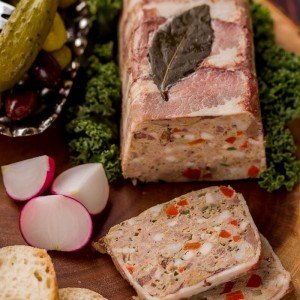
Country Style Pate - rich, incredibly flavorful pate recipe goes great with a fresh crusty baguette and a pickle. If you've never made this at home, do it at least once. Step by step pictures will be there to guide you every step of the way.
- 1 Tbsp. Unsalted Butter
- ½ cup diced shallots or yellow onion
- 1 lb. pork ground
- ½ lb bacon diced finely
- 4-8 strips bacon thin or regular thickness
- 6 oz. chicken livers trimmed and cut into small ½" pieces
- 2 Tbsp heavy whipping cream
- 1 egg large
- 2 Tbsp minced fresh thyme leaves
- 3-4 cloves garlic minced (about 1 Tbsp)
- 1½ tsp kosher salt
- 2-3 Tbsp carrots cooked and diced
- 2 Tbsp diced pickles or cornichons
- ½ tsp ground black pepper
- 2 Tbsp cognac Optional
- 2-3 fresh or dried bay leaves
-
Saute onions: In a skillet sweat ½ cup diced shallots or yellow onionwith 1 Tbsp. Unsalted Butter over medium heat until translucent, about 3 minutes .
-
Mix the meats: Combine 1 lb. pork, ½ lb bacon, and 6 oz. chicken livers until evenly distributed.
-
Liquids + herbs: In a separate bowl mix 1 egg, 2 Tbsp heavy whipping cream, 3-4 cloves garlic , 2 Tbsp cognac, 2 Tbsp minced fresh thyme leaves, ½ tsp ground black pepper, and 1½ tsp kosher salt.
-
Mix: Now bring the meat mixture, herby liquid mixture, 2-3 Tbsp carrots 2 Tbsp diced pickles or cornichons and sauted onions together and mix thoroughly.
-
Fill the pans:
Preheat oven to 350 °F with the rack in the center.
Divide the 2-3 fresh or dried bay leaves between the bottoms of two 3" x 6" mini loaf pans, or place all bay leaves onto the bottom of one 4" x 9" baking pan.
Now line the form with 4-8 strips bacon, slightly overlapping, and allowing the ends to hang over the form. You will later wrap the filling with the ends that overhang. I cut each strip in half, instead of using the whole strip, which I regretted later.
-
Rap the filled pan hard against the counter 8 to 10 times to bring out any trapped bubbles that might have formed and to compact the meat mixture.
Cover the filled loaf pan with foil and wrap the ends tightly against the sides of the pan.
-
Set the filled loaf pans inside a 9"x13"baking pan. Put it on the oven rack first, then pour boiling water into the outer pan until it comes halfway up the sides of the loaf pans. (Note 4)
Insert a leave-in probe thermometer into the center of one loaf and run the cord out through the oven door.
-
Bake at 350°F until it reads 165°F, about 1 hour for the 6x3 pans, or around 1 hours 30 minutes for the 8x.4 Go by temperature not the time.
-
Weight it down: Remove the baking pan from the oven. Lift the loaf pans out of the water, then pour the water out of the baking pan. Keep the juices inside the loaf pans, the pâté reabsorbs them as it cools.
Set the loaf pans back into the empty baking pan. Lay a small cutting board on top and set a couple of heavy cans on it. The weight compresses the terrine so it slices clean instead of crumbling.
Cool at room temperature for about 1 hour, then remove the weights, wipe the pans dry, and refrigerate at least 8 hours or overnight. (Note 5)
-
Unmold: Peel the foil off the top, then set the loaf pan in a bowl of hot water for 20 to 30 seconds. Keep the water below the rim so it doesn't seep in. This melts the layer of fat holding the terrine to the pan.
Set a plate or serving board upside down on top of the pan, hold the two together tightly, and flip in one motion. The terrine drops onto the plate with the bay leaves and bacon on top. If it doesn't release, return the pan to the hot water for another 20 seconds. Don't shake it.
-
To serve: For clean slices, dip your knife in hot water and wipe it dry between each cut, not just the first one. Cut into ¾-inch slices.
Serve with cornichons or a pickle and a fresh crusty baguette. The sharpness cuts right through the richness.
NGREDIENTS
Note 1 — Salt. 1½ teaspoons Morton kosher salt. The amount looks low for 2 pounds of meat, but nearly half of that meat is bacon, which brings its own salt. If you use Diamond Crystal, use 2 teaspoons.
Note 2 — Bacon, two kinds. The ½ lb finely diced bacon goes into the meat mixture. The 4 to 8 whole strips line the pans. Use whole strips for lining. Short pieces don't reach over the top to wrap the filling.
PANS & BAKING
Note 3 — Pan size sets the bake time. Two 6x3 mini loaf pans: about 1 hour 15 minutes. One 9x4 or 9x5 pan: about 1 hour 30 minutes. What matters is how deep the pâté sits, not how big the pan looks. Whatever pan you use, go by the thermometer: 165°F in the center; start checking at 1 hour.
Note 4 — Rap the pans. Air pockets become holes on the cut face, and they insulate, which can leave a cool spot in a loaf that has to reach 165°F. Rap until bubbles stop rising.
Note 5 — Boiling water, not hot tap water. A pan of warm water spends the first half hour of the bake heating itself up while the pâté does nothing. Pour it in with the pan already on the oven rack.
Note 6 — Probe placement. Push the probe through the foil into the middle of the loaf, depth-wise, without touching the pan bottom. Touching metal reads hot and tells you it's done before it is. With two pans, probe one and confirm the second with an instant-read before pulling both. Ovens have hot spots.
AFTER BAKING
Note 7 — Weighting. Set a small cutting board flat on top of the pans and weigh it down with a couple of heavy cans. The pans are filled nearly to the rim, so the board presses right on the pâté through the foil. Keep the juices in the pans. The pâté reabsorbs them as it cools.
Note 8 — Chill time. 8 hours minimum to slice cleanly. Best flavor is on day 2, so this is a true make-ahead. Making it a day or two before serving still leaves days of storage.
STORAGE & SERVING
Note 9 — Storage. Uncut and wrapped: up to 5 days in the fridge. Once cut: press plastic wrap directly against the cut face and eat within 3 days. Freezes well in slices, wrapped tightly, up to 2 months. Thaw overnight in the fridge.
Note 10 — Servings. Each 6-inch loaf slices into 8 pieces, about ¾ inch thick. Serves 16 as an appetizer, or 12 heartier lunch portions with a baguette and a pickle. Dip the knife in hot water and wipe between each cut.