
Country Style Pâté Recipe
Country pâté (pâté de campagne, French for “country-style pâté”) is a rustic loaf of seasoned ground pork, bacon, and chicken liver, baked slowly in a water bath, then chilled and sliced. It tastes rich and deeply savory, and it is easier to make than it looks. I adapted this recipe from America’s Test Kitchen years ago, and it has been on my holiday table ever since.
If you love make-ahead appetizers like this, my chicken liver mousse with balsamic onions and cured salmon belong on the same board.
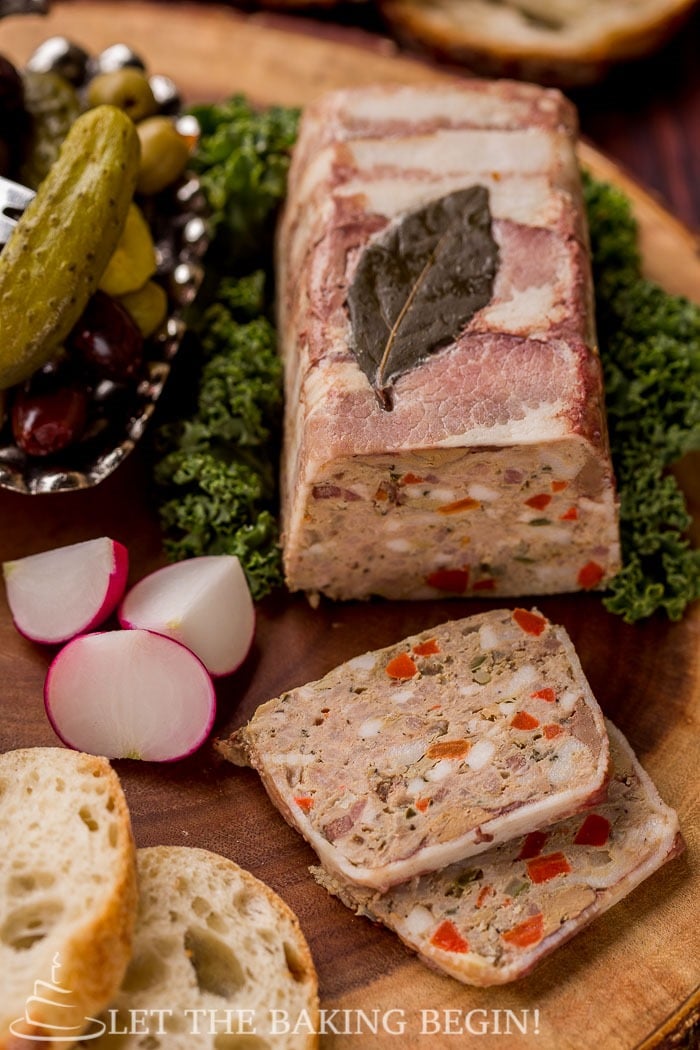
Why you’ll Love this Country Pâté
This is the appetizer that looks like it came from a French deli counter, made with regular grocery store ingredients.
- No special equipment – regular loaf pans, no terrine mold. A probe thermometer does the hard part for you.
- A true make-ahead – it actually tastes best on day 2, so making it ahead is not a compromise. It is the plan.
- Feeds a crowd – one batch serves 16 as an appetizer, and it holds in the fridge for days.
- A beautiful cut face – little pockets of carrot and pickle make every slice look like a mosaic.
What is Pâté?
Pâté is a seasoned blend of ground meat and liver, cooked and served cold in slices or as a spread. The French word just means “paste.”
Country style means coarse, not smooth. Instead of a silky spread, you get a firm, sliceable loaf with texture, like a very fancy cold meatloaf. And I mean that as a compliment.
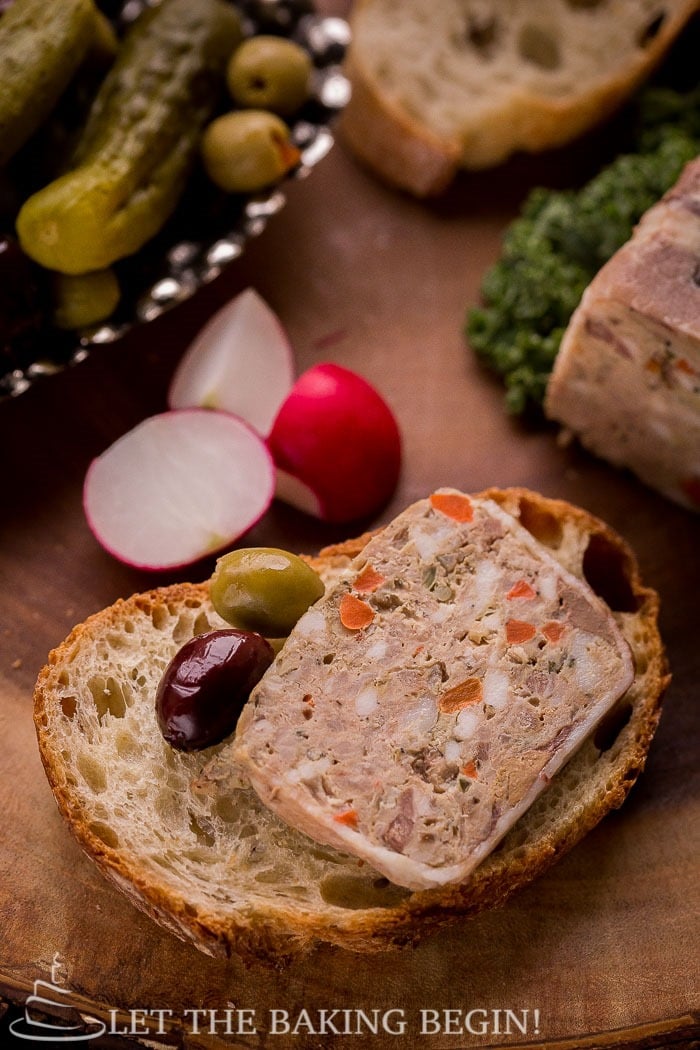
Ingredients for Country Style Pâté
Every ingredient here has a job. Here is what each one brings, and what you can swap. Amounts are in the recipe card below.
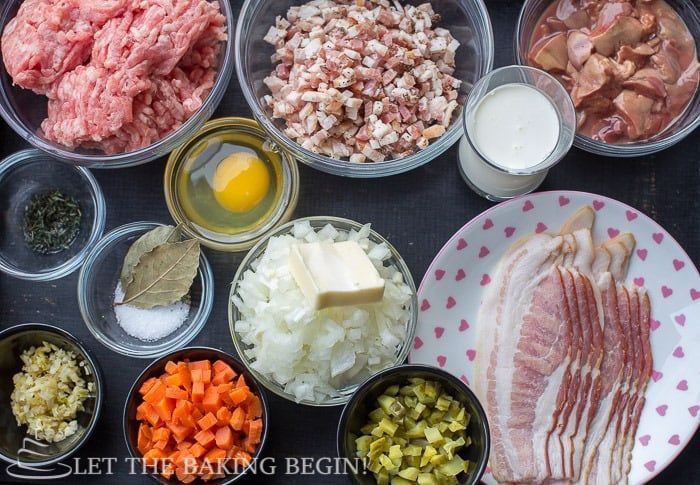
- Ground pork – the base of the loaf. Use regular ground pork, not lean. The fat is what keeps the pâté moist and sliceable.
- Bacon, two ways – finely diced bacon goes into the mix for salt and smoke. Whole strips line the pans, keep the edges moist, and make that classic striped look when you unmold the loaf. Use whole strips to line the pans. Short pieces will not reach over the top.
- Chicken livers – they’re the whole point. Pâté without liver is just meatloaf. Trim away any greenish spots and the stringy bits. That is where bitterness comes from.
- Egg and heavy cream – the binders. They hold the loaf together and add richness.
- Shallots, garlic, and fresh thyme – the aromatics. Yellow onion works in place of shallots. Fresh thyme is worth it here.
- Bay leaves – they go into the pan first, so they end up on top when you flip the loaf out. Pretty and fragrant.
- Cooked carrots and cornichons – cornichons are tiny tart French pickles. Any small dill pickle works. These make the sweet and briny pockets in every slice.
- Kosher salt – I use Morton. The amount looks small for this much meat, but the bacon brings plenty of its own salt.
- Black pepper – freshly ground if you can.
- Cognac, optional – the original America’s Test Kitchen recipe includes it, and readers who add a splash swear by it. Brandy works too.
How to Make Country Style Pâté (Step-by-Step)
The method is simple: mix, fill, bake in a water bath, then chill under a weight. The photos below walk you through each stage, and the recipe card has the exact amounts and times.
- Sweat the aromatics.
- Cook the shallots in butter over medium heat until soft and see-through.
- You are not browning them, just taking the raw edge off.
- Let them cool a little before they meet the raw meat.
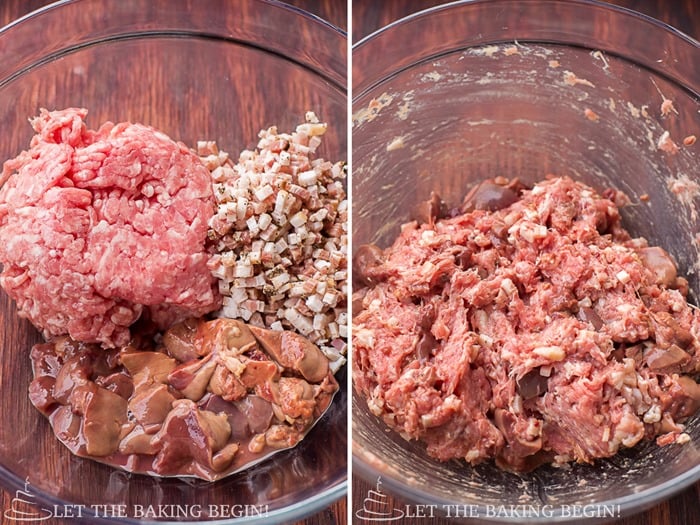
- Mix the meats.
- Combine the ground pork, diced bacon and chopped livers in a large bowl.
- Use your hands. A spoon will not distribute the livers evenly, and you want every slice to taste the same.
- Keep the bacon strips aside. They are for lining the pans, not for the mix.

- Whisk the binder.
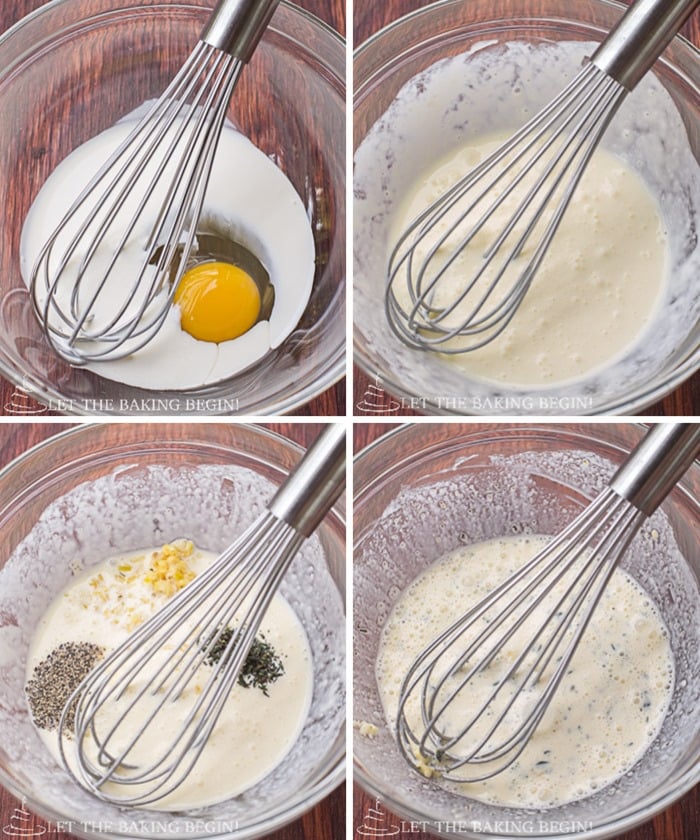
- In a separate bowl, whisk the egg, cream, garlic, thyme, salt and pepper.
- Mixing the seasoning into the liquid first means it spreads evenly through the meat. Salt dumped straight onto the meat lands in pockets.

- Bring it all together.
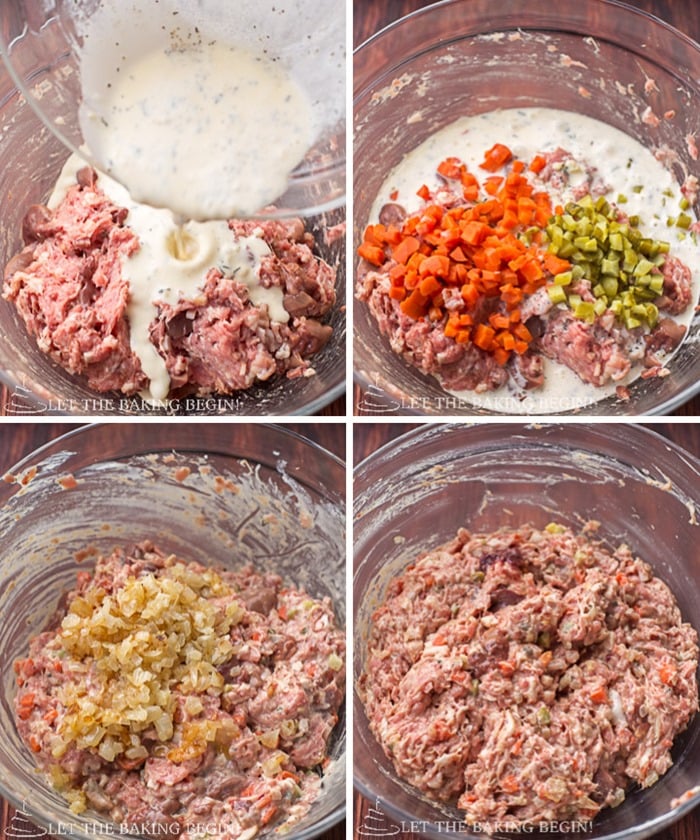
- Add the binder, carrots, cornichons and cooled onions to the meat.
- Mix until everything is evenly spread through, and then stop.
- Overmixing makes the texture dense and springy instead of tender.
- Line the pans.
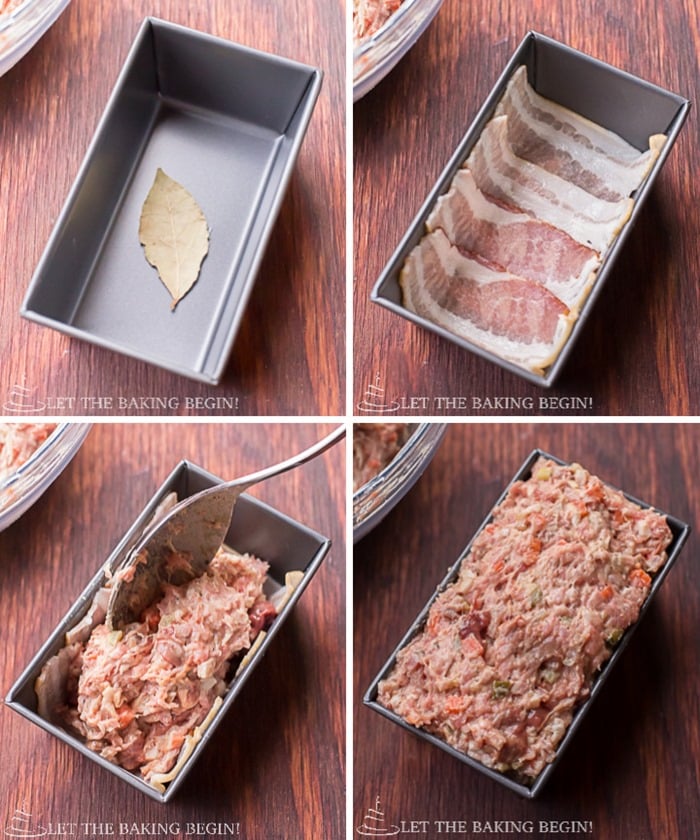
- Lay the bay leaves on the bottom first, shiny side down. When you unmold the pâté upside down later, they become the decoration on top.
- Line the pans with whole bacon strips, slightly overlapping, with the ends hanging over the sides.
- Those overhanging ends will fold over to wrap the top, so do not trim them.
- Fill, rap, and wrap.
- Fill the pans in a few additions, pressing the mixture into the corners as you go.
- Rap each filled pan firmly against the counter until bubbles stop rising. A meat mixture is stiff and traps air, and trapped air becomes holes on the cut face.
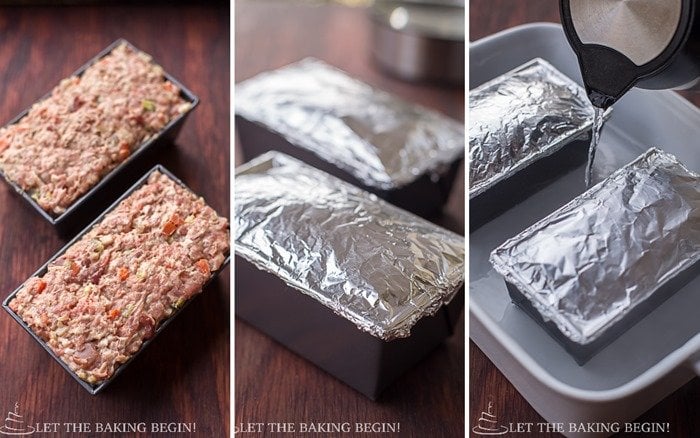
- Fold the bacon ends over the top, then cover each pan tightly with foil.
- Set up the water bath.
- Set the pans inside a deep baking pan, put the whole thing on the oven rack, and only then pour boiling water halfway up the sides of the loaf pans.
- Pouring in place means you never carry a pan of boiling water across the kitchen.
- Why a water bath at all? Water cannot go past 212°F, so the edges of the pâté cook gently while the middle catches up. There is egg in this mixture, and egg that cooks too hot at the edges turns tight and grainy.
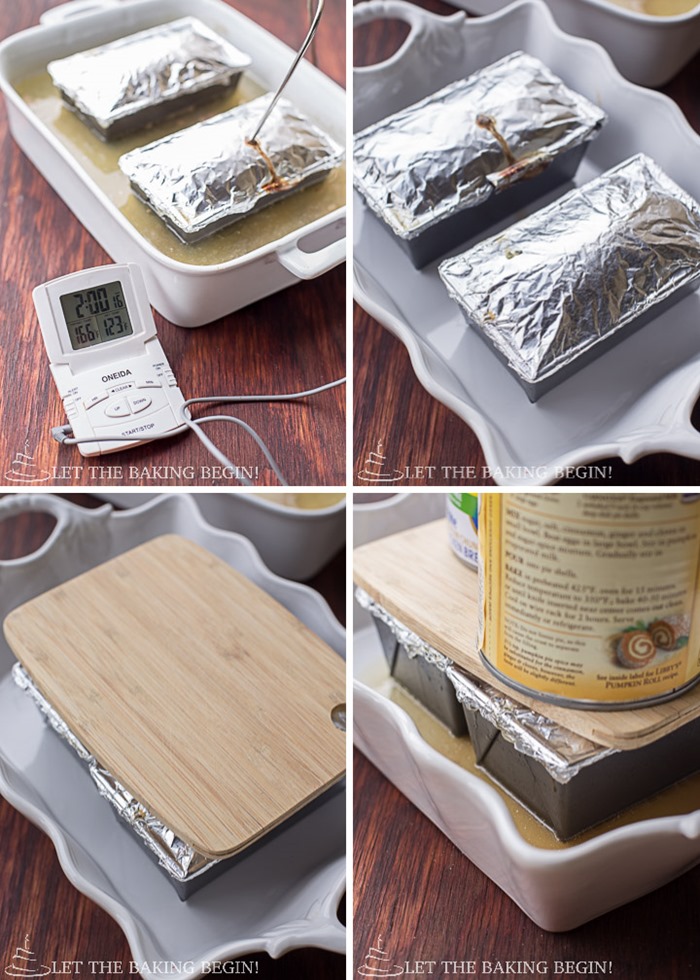
- Push a probe thermometer through the foil into the middle of one loaf and run the cord out the oven door.

- Bake to temperature, not to time.
- Bake until the probe reads 165°F in the center. The clock is only an estimate. The thermometer is the answer.
- How long it takes depends on how deep the pâté sits, not how much it weighs. Times for both pan setups are in the recipe card.
- Because the water bath does the regulating, there is no rush and no guesswork. Just wait for the number.

- Weight it and chill.
- Lift the pans out, pour off the water, and set the pans back in the empty baking pan. Keep the juices in with the pâté. It drinks them back up as it cools.
- Lay a small cutting board across the tops and set a couple of heavy cans on it. The weight presses the loaf into a dense, sliceable texture instead of a crumbly one.
- Cool about an hour at room temperature, then refrigerate at least 8 hours.
- Unmold and slice.
- Peel off the foil, then dip the pan in hot water for 20 to 30 seconds to loosen the fat holding the loaf in place.
- Set a plate upside down on the pan, hold the two together tightly, and flip in one motion. Bay leaves and bacon land on top.
- Slice with a hot, wiped knife. Dip and wipe between every cut, not just the first one.
Marina’s Pro Tips for theBest Country Pâté

These are the small things that separate a pâté that slices like a dream from one that crumbles or disappoints.
- Trim the livers well. Bitterness in pâté almost always comes from bile left on the liver, not from the liver itself. Cut away anything greenish.
- Rap out the air. Air pockets turn into holes on the cut face, and the cut face is the whole show.
- Boiling water only. Warm tap water spends the first half hour of the bake heating itself up while your pâté sits there doing nothing.
- Go by the thermometer. The center must reach 165°F. Chicken liver is poultry, and unlike a steak, it is not safe pink. A probe thermometer means you never open the oven to check.
- Do not skip the weight. Press the loaf while it cools, so it slices clean instead of crumbling.
- Make it a day ahead. The flavors need a night together. Day 2 pâté beats day 1 pâté every time.
- Hot knife, wiped between cuts. One dip is not enough. Dip and wipe before every slice for clean, deli-counter cuts.
Ways to Serve Country Pâté
Pâté is rich, so serve it with things that cut through the richness.
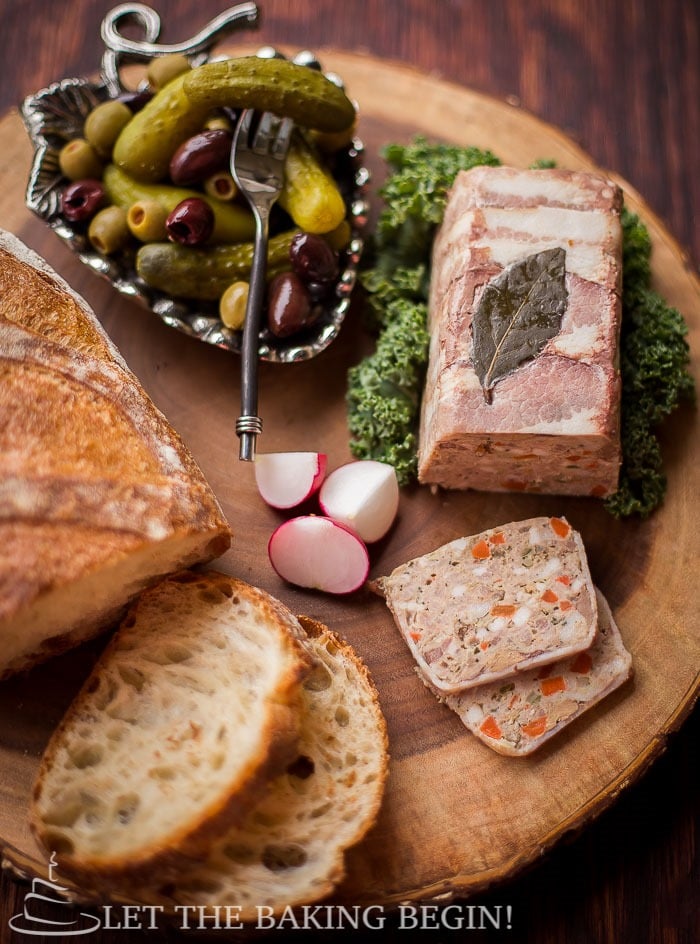
- The classic – thick slices of fresh crusty baguette, cornichons or a good dill pickle, and grainy mustard.
- On an appetizer board – alongside cured salmon, olives, and portobello mushroom crostini.
- As lunch – two slices, bread, pickles, and you are done. This is my favorite way.
Make It Ahead
This recipe is built for making ahead. It needs at least 8 hours in the fridge before you can slice it, and it tastes noticeably better on day 2, after the flavors have had a night to meld. Make it 1 to 2 days before your gathering and the timing works entirely in your favor.
How to Store Country Pâté
- Uncut: wrapped well in the fridge, it keeps up to 5 days without losing anything.
- Once cut: press plastic wrap directly against the cut face and eat within 3 days. The cut surface is where it dries out and discolors.
- Freezer: wrap individual slices tightly and freeze up to 2 months. Thaw overnight in the fridge.
Country Pâté FAQ
Why did my pâté crumble when I sliced it?
Why is my pâté dry or gray?
Is pink pâté safe to eat?
What is pâté de campagne?
What is the difference between pâté and terrine?
Can I make pâté without the liver?
Can I use a different pan size?
Can I add cognac or brandy?
More Appetizers to Try
If this pâté is your kind of appetizer, these are the next ones to make.
- Chicken Liver Mousse with Balsamic Onions – the smooth, spreadable cousin of this recipe.
- Skewered Chicken Pâté Stacks – the party-bite version of pâté.
- Fried Chicken Liver with Onions – the quick weeknight way to cook chicken livers.
- Cured Salmon, Selyodka Style – another make-ahead board staple.
Made this recipe?
Please leave a ⭐⭐⭐⭐⭐ star rating and a comment below.
It helps other readers find it, and I love reading every single one.
Country Style Pate (American Test Kitchen Recipe)
Country Style Pate - rich, incredibly flavorful pate recipe goes great with a fresh crusty baguette and a pickle. If you've never made this at home, do it at least once. Step by step pictures will be there to guide you every step of the way.
Ingredients
Ingredients
- 1 Tbsp. Unsalted Butter
- ½ cup (80 g) diced shallots or yellow onion
The meats
- 1 lb. pork ground
- ½ lb (227 g) bacon diced finely
- 4-8 strips bacon thin or regular thickness
- 6 oz. chicken livers trimmed and cut into small ½" pieces
Aromatics
- 2 Tbsp heavy whipping cream
- 1 (50 g) egg large
- 2 Tbsp minced fresh thyme leaves
- 3-4 cloves garlic minced (about 1 Tbsp)
- 1½ tsp kosher salt
- 2-3 Tbsp carrots cooked and diced
- 2 Tbsp diced pickles or cornichons
- ½ tsp ground black pepper
- 2 Tbsp cognac Optional
- 2-3 fresh or dried bay leaves
Instructions
-
Saute onions: In a skillet sweat ½ cup diced shallots or yellow onionwith 1 Tbsp. Unsalted Butter over medium heat until translucent, about 3 minutes .
-
Mix the meats: Combine 1 lb. pork, ½ lb bacon, and 6 oz. chicken livers until evenly distributed.
-
Liquids + herbs: In a separate bowl mix 1 egg, 2 Tbsp heavy whipping cream, 3-4 cloves garlic , 2 Tbsp cognac, 2 Tbsp minced fresh thyme leaves, ½ tsp ground black pepper, and 1½ tsp kosher salt.
-
Mix: Now bring the meat mixture, herby liquid mixture, 2-3 Tbsp carrots 2 Tbsp diced pickles or cornichons and sauted onions together and mix thoroughly.
-
Fill the pans:
Preheat oven to 350 °F with the rack in the center.
Divide the 2-3 fresh or dried bay leaves between the bottoms of two 3" x 6" mini loaf pans, or place all bay leaves onto the bottom of one 4" x 9" baking pan.
Now line the form with 4-8 strips bacon, slightly overlapping, and allowing the ends to hang over the form. You will later wrap the filling with the ends that overhang. I cut each strip in half, instead of using the whole strip, which I regretted later.
-
Rap the filled pan hard against the counter 8 to 10 times to bring out any trapped bubbles that might have formed and to compact the meat mixture.
Cover the filled loaf pan with foil and wrap the ends tightly against the sides of the pan.
-
Set the filled loaf pans inside a 9"x13"baking pan. Put it on the oven rack first, then pour boiling water into the outer pan until it comes halfway up the sides of the loaf pans. (Note 4)
Insert a leave-in probe thermometer into the center of one loaf and run the cord out through the oven door.
-
Bake at 350°F until it reads 165°F, about 1 hour for the 6x3 pans, or around 1 hours 30 minutes for the 8x.4 Go by temperature not the time.
-
Weight it down: Remove the baking pan from the oven. Lift the loaf pans out of the water, then pour the water out of the baking pan. Keep the juices inside the loaf pans, the pâté reabsorbs them as it cools.
Set the loaf pans back into the empty baking pan. Lay a small cutting board on top and set a couple of heavy cans on it. The weight compresses the terrine so it slices clean instead of crumbling.
Cool at room temperature for about 1 hour, then remove the weights, wipe the pans dry, and refrigerate at least 8 hours or overnight. (Note 5)
-
Unmold: Peel the foil off the top, then set the loaf pan in a bowl of hot water for 20 to 30 seconds. Keep the water below the rim so it doesn't seep in. This melts the layer of fat holding the terrine to the pan.
Set a plate or serving board upside down on top of the pan, hold the two together tightly, and flip in one motion. The terrine drops onto the plate with the bay leaves and bacon on top. If it doesn't release, return the pan to the hot water for another 20 seconds. Don't shake it.
-
To serve: For clean slices, dip your knife in hot water and wipe it dry between each cut, not just the first one. Cut into ¾-inch slices.
Serve with cornichons or a pickle and a fresh crusty baguette. The sharpness cuts right through the richness.
Recipe Notes
NGREDIENTS
Note 1 — Salt. 1½ teaspoons Morton kosher salt. The amount looks low for 2 pounds of meat, but nearly half of that meat is bacon, which brings its own salt. If you use Diamond Crystal, use 2 teaspoons.
Note 2 — Bacon, two kinds. The ½ lb finely diced bacon goes into the meat mixture. The 4 to 8 whole strips line the pans. Use whole strips for lining. Short pieces don't reach over the top to wrap the filling.
PANS & BAKING
Note 3 — Pan size sets the bake time. Two 6x3 mini loaf pans: about 1 hour 15 minutes. One 9x4 or 9x5 pan: about 1 hour 30 minutes. What matters is how deep the pâté sits, not how big the pan looks. Whatever pan you use, go by the thermometer: 165°F in the center; start checking at 1 hour.
Note 4 — Rap the pans. Air pockets become holes on the cut face, and they insulate, which can leave a cool spot in a loaf that has to reach 165°F. Rap until bubbles stop rising.
Note 5 — Boiling water, not hot tap water. A pan of warm water spends the first half hour of the bake heating itself up while the pâté does nothing. Pour it in with the pan already on the oven rack.
Note 6 — Probe placement. Push the probe through the foil into the middle of the loaf, depth-wise, without touching the pan bottom. Touching metal reads hot and tells you it's done before it is. With two pans, probe one and confirm the second with an instant-read before pulling both. Ovens have hot spots.
AFTER BAKING
Note 7 — Weighting. Set a small cutting board flat on top of the pans and weigh it down with a couple of heavy cans. The pans are filled nearly to the rim, so the board presses right on the pâté through the foil. Keep the juices in the pans. The pâté reabsorbs them as it cools.
Note 8 — Chill time. 8 hours minimum to slice cleanly. Best flavor is on day 2, so this is a true make-ahead. Making it a day or two before serving still leaves days of storage.
STORAGE & SERVING
Note 9 — Storage. Uncut and wrapped: up to 5 days in the fridge. Once cut: press plastic wrap directly against the cut face and eat within 3 days. Freezes well in slices, wrapped tightly, up to 2 months. Thaw overnight in the fridge.
Note 10 — Servings. Each 6-inch loaf slices into 8 pieces, about ¾ inch thick. Serves 16 as an appetizer, or 12 heartier lunch portions with a baguette and a pickle. Dip the knife in hot water and wipe between each cut.

Thank you for following me on Instagram, Facebook & Pinterest!
Hashtag your photos #LetTheBakingBeginBlog so I can see your creations and for a chance to be featured!
I first published this country pâté in 2015, and it has fed a decade of my holiday tables since. In August 2026, I updated it with accurate bake times for both pan sizes, a probe thermometer method that takes out the guesswork, corrected salt, new storage guidance, and a fully rewritten step-by-step.
Marina | Let the Baking Begin

















So, is it 1.5 tablespoons of salt or 1.5 teaspoons of salt?
1.5 teaspoons.
Great recipe, I added 2 tbsp of Cognac, turned out great, friends loved it! Sliced, vacuumed it and put in the freezer
Looking forward to making this soon! Just to clarify: the extended ends of bacon are folded over the compacted pâté before it is wrapped in tinfoil and baked?
Yep, you got that right. Hope you love it when you make it!
Hi Marina.
Is there a substitute for the livers?
While I would like them, but if I used them no-one else would eat any.
But that might be a good idea! lol
Ken
Hi Ken, You can probably just use more pork in place of livers.
Presuming this is intended to be “Liver” Pâté…. It includes an excessive amount of salt and bacon (more salt), excessive amount of Pork, and significant lack of Liver.
Finished presentation was appealing however taste was akin to a salty meatloaf.
I liked the “additives” (carrots, pickles, seasonings)
Are the carrot and pickle necessary? I don’t usually see those inside the pate, more as garnish.
They’re more for the contrast of color. If you’d rather not use them, you’re welcome to omit them.
It was so so good when you made it !!! Have to make it my self now
I made this for holiday. everyone like it. Very good, very tasty. Thank you for great recepe.
Thank you for your feedback Snezhana! I’m glad you guys liked it!
Hi folks,
I made this yesterday, followed the directions exactly. The only issue is that mine didn’t come out with that beautiful pinkish look like the picture. Did I do something wrong? Cooked it till 165 degrees!
Hi Brent,
Hmmm, not sure what could’ve caused it. Did you remove it from the water bath immediately after baking? This would ensure that the cooking wouldn’t continue. If you did that, not sure what else could’ve caused this… 🙁
you Explained the process very well!
Thank you for linking to original recipe – that’s where I found the temp to bake it at! Great recipe everyone loved it!
i wonder how different it would be if I made it with pork liver instead ?
I think you can totally use pork liver. The flavor might be a bit richer, but still very good!
Спасибо за рецепт. Очень вкусно получилось!
🙂
This pate looks amazing! I love pate in restaurants, but haven’t had the guts to make them. Your recipe doesn’t look too hard. I will need to check it out soon. By the way, I would love some bread and pate now. 😛
OMG!!! You are bringing to me so many beautiful memories!!! My grandparents used to do something very similar for holidays!!! they didn’t used bacon on top ( that’s a classy touch!!) but was very similar to this one!!! Thanks for this recipe!
Cat
Hi Cat!
The bacon isn’t just for the flavor though, it also seals in the Pate keeping it fresh for a couple days.
So interestin, never tried anything like this. Looks like something my parents would love!!.
I think if you tried it you would also like it, not just your parents 😉