
Mikado Layer Cake with Chocolate Custard Buttercream
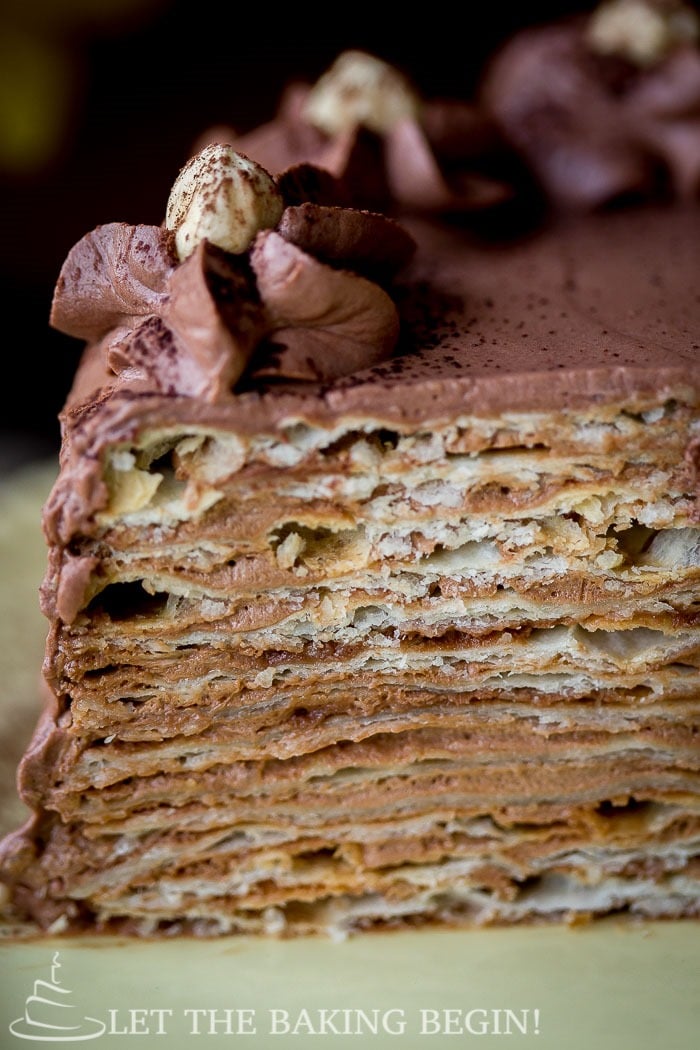
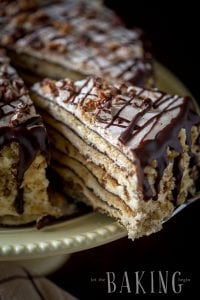
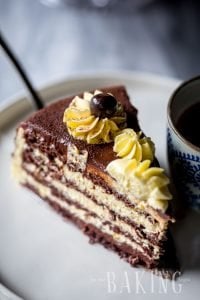
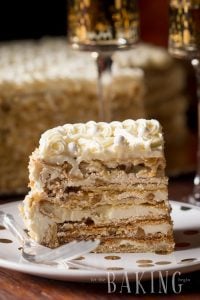
Mikado cake is a classic Armenian layer cake: thin, flaky layers stacked with a rich chocolate custard buttercream. The layers bake up crisp. Overnight, they soften into a tender cake that melts in your mouth.
If thin-layer cakes are your thing, you will probably also love my Spartak Cake, the classic Russian Napoleon Cake, and the Esterhazy Cake with its silky custard buttercream.
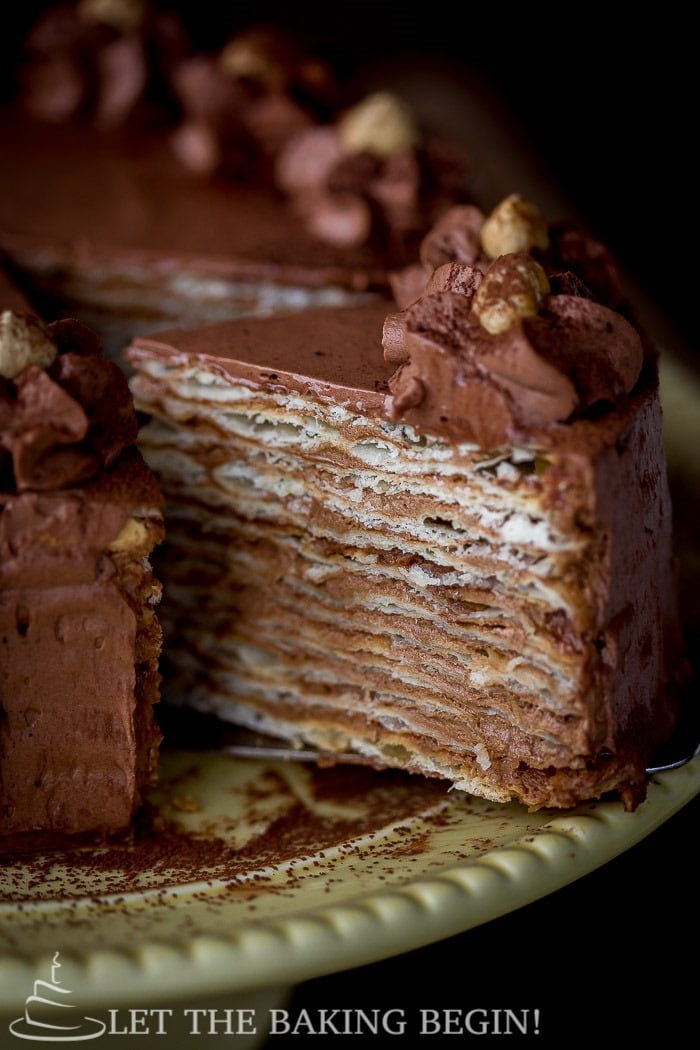
A reader first asked me for this recipe on Facebook, and I found it on Armine’s blog (thank you, Armine!). One bite and I understood why she wanted it so badly.
Here’s why you’ll Love this cake
Here’s what makes this cake a keeper:
- Thin, flaky layers – crisp like cookies out of the oven, soft and tender after a night in the frosting.
- That chocolate custard buttercream – a cooked chocolate custard AND dulce de leche whipped into butter.
- Built to be made ahead – the cake NEEDS to rest overnight, so it is done and waiting before your guests arrive.
- Simple pantry ingredients – flour, eggs, sour cream, butter, cocoa. Nothing you need to hunt down.
- No special equipment – just a rolling pin, a round pan to trace, and a mixer.
What is Mikado Cake?
Mikado goes back to the Soviet era and still shows up on almost every holiday table in Armenian homes. The layers come out of the oven hard, like big cookies. Overnight, they soak up the frosting and soften.
The classic Armenian version uses a dulce de leche buttercream. Dulce de leche is sweetened condensed milk cooked until thick and caramel-colored. My version adds a cooked chocolate custard to that same frosting, so you get chocolate and caramel in every bite.
Ingredients for Mikado Cake
The frosting comes first, so here are its ingredients. Here’s what each one does and what you can swap. Exact amounts are in the recipe card at the bottom of the post.
For the chocolate custard buttercream
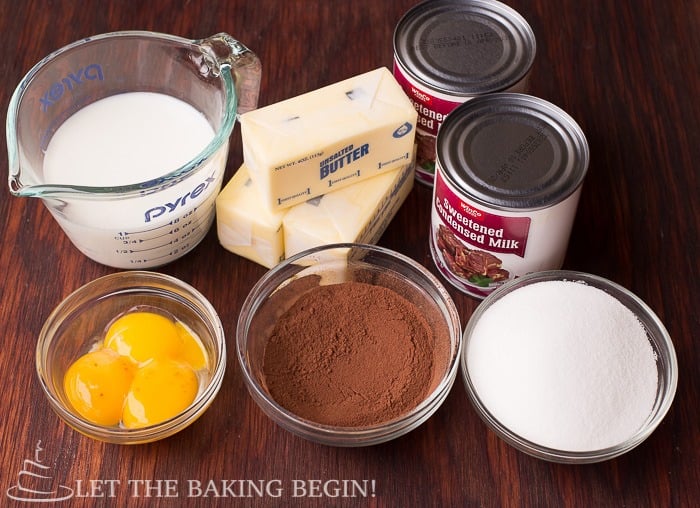
- Egg yolks – they thicken the custard and make it rich and silky.
- Sugar and milk – the base of the custard.
- Cocoa powder – use a good unsweetened cocoa. It carries all the chocolate flavor here.
- Dulce de leche – boiled sweetened condensed milk. Buy it canned or boil a can of sweetened condensed milk yourself. It brings the caramel flavor the classic Mikado is known for.
- Butter – room temperature, no shortcuts here. Cold butter will not whip. Melted butter makes a greasy frosting.
- Heavy whipping cream, powdered sugar, and cocoa – whipped together for the chocolate cream that covers the outside. Use cold cream with 33% fat or higher, or it will not whip.
How to Make Mikado Cake
The order matters: make the frosting first, then bake and stack the layers. Here are the steps. Full details are in the recipe card below.
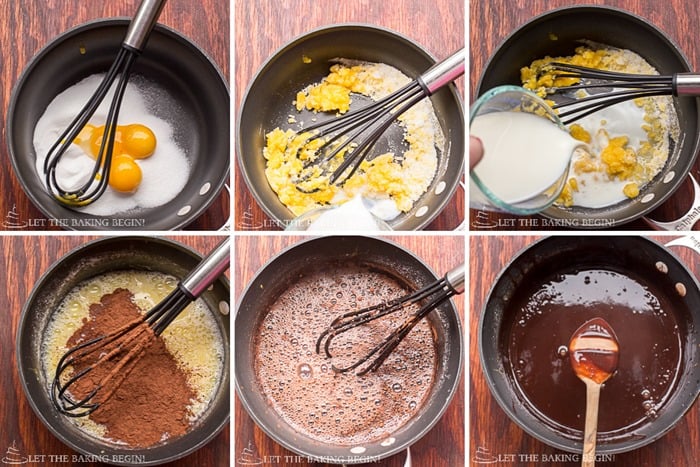
- Cook the chocolate custard.
- Whisk the egg yolks and sugar together in a saucepan, then whisk in the milk and cocoa.
- Cook over medium heat, whisking the whole time, until it thickens enough to coat a spoon.
- Press plastic wrap directly onto the surface to prevent a skin from forming. Cool to room temperature.
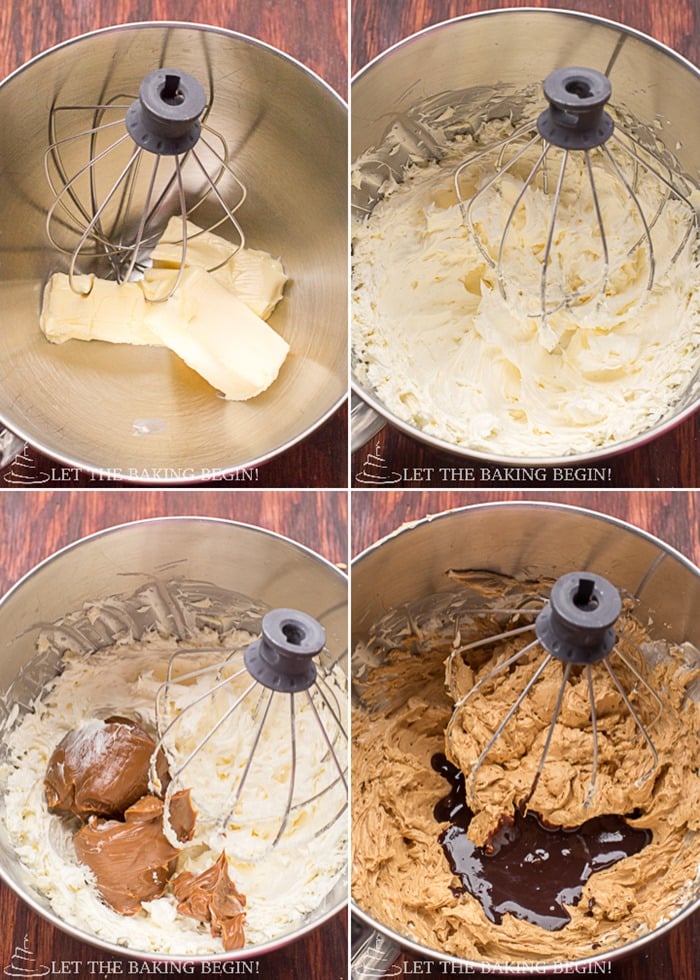
- Whip the buttercream.
- Whip room-temperature butter for about 5 minutes, until lighter in color and fluffy.
- Add the dulce de leche in two additions, whipping well after each one.
- Add the cooled chocolate custard in two additions, whipping until smooth. Set aside.
Ingredients For the Mikado cake layers
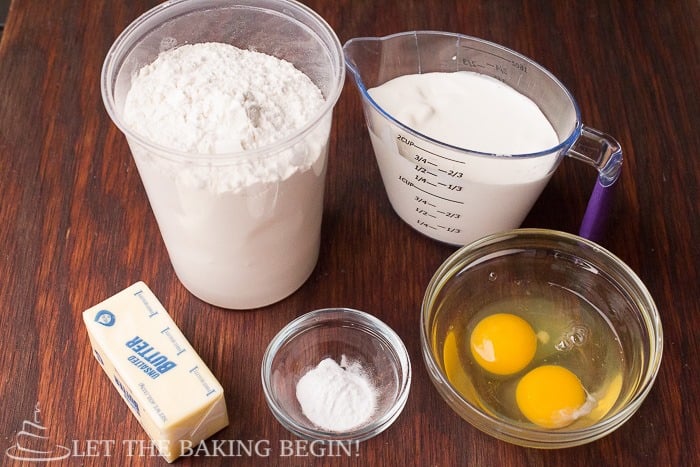
- Butter – room temperature so it whips smooth. Pull it out of the fridge at the same time as the eggs.
- Eggs – room temperature. They blend into the dough evenly.
- Sour cream – the secret to the flaky layers. Use full-fat for the most tender result.
- Baking soda – it wakes up when it meets the sour cream’s acid. That little lift keeps the thin layers from baking like crackers.
- All-purpose flour – fluff it, scoop, and level off. Add just enough to make a soft dough that doesn’t stick to your hands. Too much flour makes tough layers.
How to make the layers:
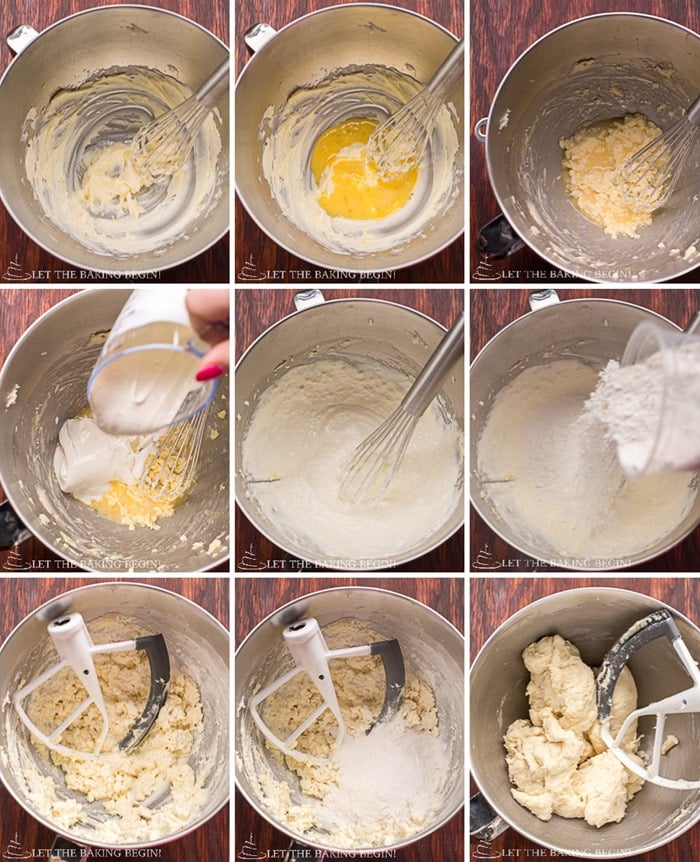
- Make the dough.
- Whip the butter. Mix in the eggs, then the sour cream and baking soda.
- Work in the flour until you have a soft dough that no longer sticks to your hands.
- Stop mixing as soon as it comes together – overworked dough bakes into tough layers.
- Roll and bake the layers.
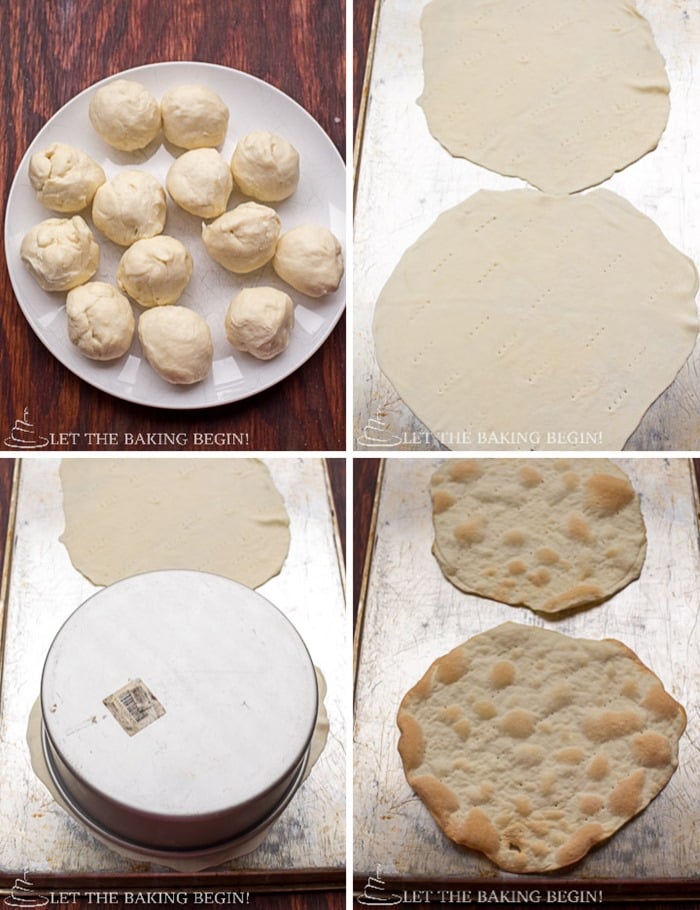
- Split the dough into 13-14 pieces, about 80 g each, and roll them into balls. Keep them covered so they don’t dry out.
- Roll each ball on a floured surface into a circle a bit bigger than your round baking pan. Place two at a time on the back of a jelly roll pan.
- Bake until the layers are just golden – they go fast, so stay close.
- As soon as a layer comes out, set your round pan on top and trim around it with a knife. Trim while warm – cool layers crack instead of cutting clean.
- Crush the trimmings and save them. They will coat the sides of the cake.
- Stack the layers.
- Put a dab of frosting on your serving plate to hold the first layer in place.
- Top each layer with a generous spoonful of frosting and spread it to the edges.
- Keep baking, trimming, and stacking until all the layers are frosted. Save some frosting for the outside.
- A cake ring around the stacked cake keeps the sides straight while it settles. No ring? That’s fine too.
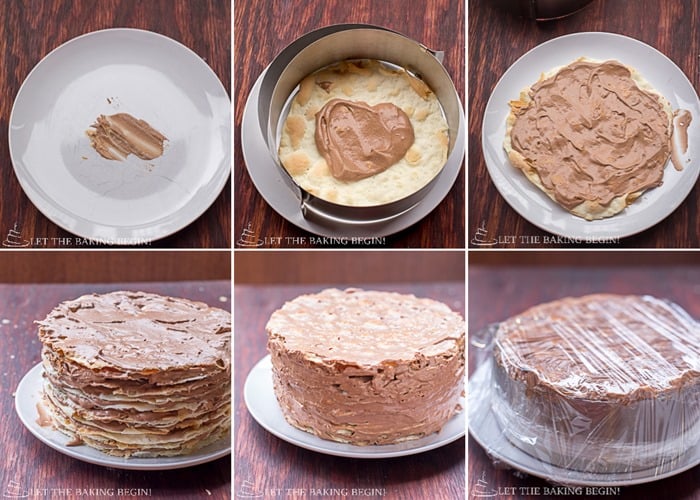
- Rest the cake overnight.
- Cover the cake and refrigerate it overnight.
- The layers soften as they absorb the frosting.
- Do not skip or shorten the rest – unrested Mikado is hard and dry.
-
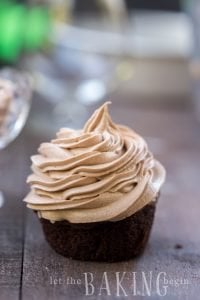
- Whip the cold heavy cream with powdered sugar and sifted cocoa until fluffy.
- Frost the top and sides of the cake with the chocolate whipped cream.
- Press the crushed trimmings onto the sides.
- Serve at room temperature. That is when the texture is best. Decorate the next day.
Marina’s Pro Tips for theBest Mikado Cake

- Whisk constantly. Stir the custard nonstop while it cooks, or the bottom will scorch. It’s cooked when it coats the back of a spoon.
- Cool custard to room temp. Otherwise, the warm custard will melt the butter when combined.
- Butter at 65-68°F whips best. That is cooler than most kitchens. It should feel cool, look matte, and dent without sliding. Warmer butter whips up greasy, and once butter starts to melt, no amount of whipping brings the fluff back. A cold stick gets there in 30-60 minutes on the counter – faster if you cut it into pieces.
- Split frosting? Keep whipping. A few more minutes usually brings it back together. Still broken? Let the bowl warm up briefly, then whip again.
- Keep dough balls covered. Uncovered dough dries out and cracks.
- Trim layers hot. Warm layers cut cleanly. Cool layers shatter.
- Use an oven thermometer. Thin layers burn fast in a hot oven.
Ways to Serve It
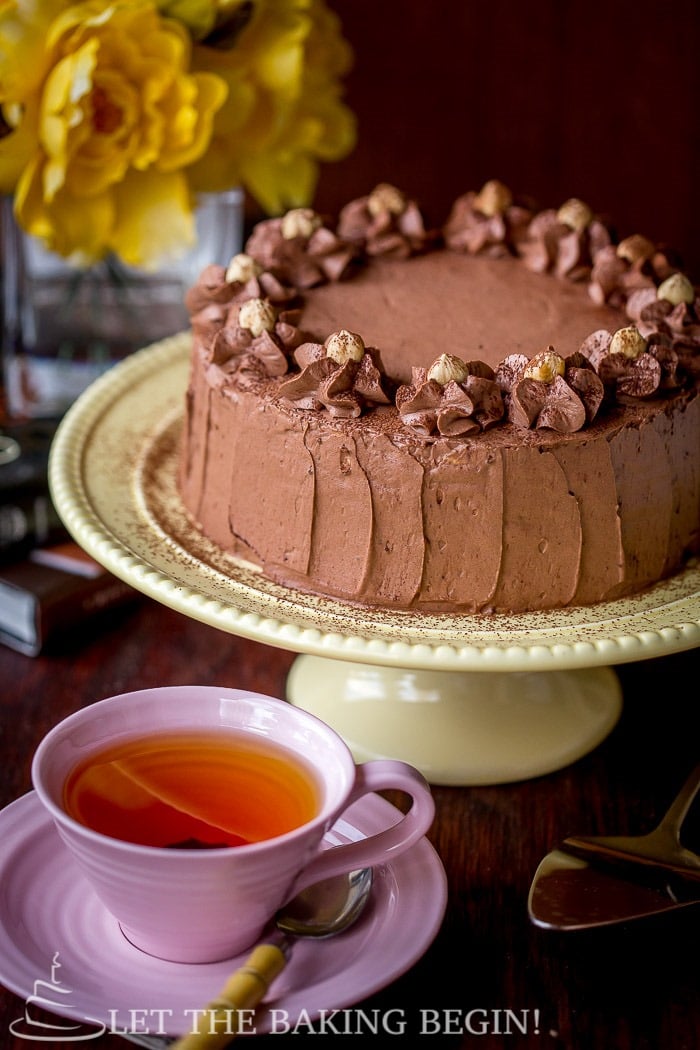
Serve Mikado at room temperature with strong black tea or coffee. That is how it is done in every Armenian home. It slices into neat, tall pieces, so it is perfect for a holiday table next to a Napoleon cake or a Dulce de Leche Cake.
Make It Ahead
This cake is meant to be made ahead – the overnight rest is part of the recipe. Build it 1-2 days before you need it and decorate the day you serve. Want to split the work? You can cook the custard up to 2 days ahead (cover with plastic wrap and refrigerate, then bring to room temperature before using). The baked layers keep for a day, well wrapped.
How to Store This Cake
- Room temperature: a few hours on the day you serve it, covered.
- Fridge: covered or in a cake keeper, up to 5-7 days. The buttercream keeps it moist. Days two and three are its best.
- Freezer: wrap whole or in slices in plastic wrap plus foil and freeze up to 2 months.
- To thaw: overnight in the fridge, then bring to room temperature before serving.
Mikado Cake FAQ
Why is it called Mikado cake?
Is Mikado cake Armenian or Russian?
What does Mikado cake taste like?
Why are my cake layers hard?
My buttercream looks curdled. Can I save it?
Can I use store-bought dulce de leche?
What is the difference between Mikado and Napoleon cake?
How long does Mikado cake need to rest?
Do I need a cake ring?
More Layer Cakes to Try
Love layer cakes? These are the ones readers make again and again:
- Spartak Cake – thin chocolate honey layers with a silky filling, Mikado’s closest cousin.
- Russian Napoleon Cake – flaky puff pastry layers with vanilla custard, the most famous thin-layer cake.
- Chocolate Kyiv Cake – chocolate, walnuts, meringue, and dulce de leche in one cake.
- Esterházy Cake – hazelnut meringue and custard buttercream, elegant and worth it.
- Dulce de Leche Cake – caramel in every part of it: the cake, the frosting, and the soak.
Made this recipe?
Please leave a ⭐⭐⭐⭐⭐ star rating and a comment below.
It helps other readers find it, and I love reading every single one.
Mikado Layer Cake with Chocolate Custard Buttercream
Ingredients
Frosting Ingredients:
- 3 (54 g) egg yolks
- 2/3 cups (133 g) granulated sugar
- 1 cup (237 ml) whole milk
- 4 Tbsp (20 g) cocoa powder
- 20 oz (567 g) sweetened condensed milk or dulce de leche 20 oz = 1 full can + 1/4 cup from the second can
- 3/4 cup (170 g) unsalted butter 340 grams, room temperature
Cake Ingredients:
- 7 Tbsp unsalted butter room temperature
- 2 large (100 g) eggs
- 1 1/2 cups (345 g) sour cream
- 1 tsp baking soda
- 3 - 3 1/2 cups (450 g) all-purpose flour 1 cup = 150 g
To Decorate
- 1 1/2 cups (355 ml) heavy whipping cream at least 33% fat content
- 1-2 Tbsp cocoa powder sifted
- 1/3 - 1/2 cups (40 g) powdered sugar
Instructions
Make the Mikado Cake Cream first
-
Mix the custard base. In a saucepan, whisk 3 egg yolks with 2/3 cups granulated sugar. Slowly whisk in 1 cup whole milk until the sugar dissolves. Add 4 Tbsp cocoa powder and mix until no cocoa streaks remain. Lumpy cocoa? Run the mixture through a sieve.
-
Cook the custard. Set over medium heat and cook, whisking nonstop so the custard does not scorch, until it thickens and coats the back of a spoon.
Do not boil - the eggs will curdle and separate.
Doneness test: dip the spoon and run your finger across the back. If the streak stays clean, the custard is done. Remove from heat and cool completely.
-
Whip the butter. With a mixer, whip 3/4 cup unsalted butter at room temperature for about 5 minutes, until lighter in color and fluffy. Scrape the sides of the bowl several times, so no butter is left unwhipped.
-
Add 20 oz sweetened condensed milk or dulce de leche in two additions, whipping well after each one.
-
Add the cooled custard in two additions, whipping thoroughly in between. Set aside until needed.
To make the cake layers
-
Make the dough. Whip 7 Tbsp unsalted butter for about a minute. Add 2 large eggs and mix well. Mix 1 1/2 cups sour cream with 1 tsp baking soda, then add to the butter mixture. Add 3 - 3 1/2 cups all-purpose flour in two additions, mixing until a dough forms. Do not overwork the dough.
-
Divide the dough. Split it into 13-14 pieces, about 80 g each, and roll into balls. Keep them covered with plastic wrap while you work.
-
Roll and bake. Flip a jelly roll sheet upside down. Roll two balls of dough directly on the back of the sheet into circles a bit bigger than an 8-inch round pan. No flour needed.
Bake at 400°F until slightly golden, about 5-7 minutes. Repeat with the rest of the dough.
-
Trim while warm. As soon as a layer is baked, set the 8 inch round pan on top and trim right around it. Crush the trimmings and save them for the sides, or freeze them in a ziplock for another cake.
-
Stack and frost. Put a dab of frosting on a plate and set the first layer on top. Add a generous spoonful of frosting, about 75 g, and spread it into an even layer.
Reserve about 1/2 cup of frosting for covering the cake at the end.
-
Repeat. Keep baking, trimming, and stacking with frosting until all the layers are done.
-
Cover and press. Cover the sides and top with the reserved frosting. Set a cake ring around the cake if you have one - it keeps the sides straight. No ring is fine too. Cover with plastic wrap, set a cutting board on top, and weigh it down with something heavy. Let it sit at room temperature for up to 24 hours.
To decorate:
-
Whip the chocolate cream. The next day, whip 1 1/2 cups heavy whipping cream with 1/3 - 1/2 cups powdered sugar and 1-2 Tbsp cocoa powder until fluffy.
-
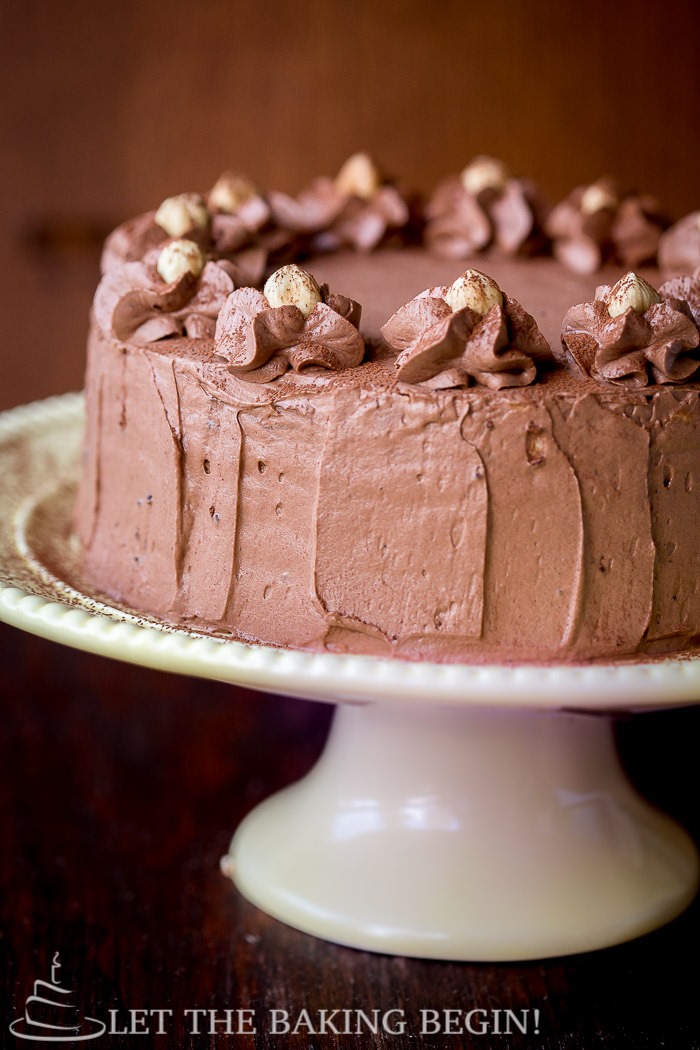
Decorate. Cover the cake in a thin layer of the whipped cream, smoothing the top. Fit a ziplock bag with a large star tip and fill it with the rest. Pipe stars along the border. Set a peeled hazelnut in the middle of each star. Dust with cocoa if you like.
-
Serve at room temperature. That is when the layers are softest.

Thank you for following me on Instagram, Facebook & Pinterest!
Hashtag your photos #LetTheBakingBeginBlog so I can see your creations and for a chance to be featured!
I first published this Mikado cake recipe in 2015, and it has been a favorite ever since. I updated the post in August 2026 with clearer steps, new pro tips, storage and make-ahead guidance, and a FAQ – the recipe itself is unchanged.
Marina | Let the Baking Begin


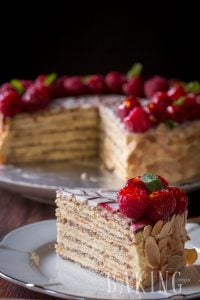











This looks really good but there seems to be a bit of an assumption that everyone knows how to make dulce de leche.
Could you clarify. Is that something you can get premade in a can or something you have to make ahead of time with sweeten condensed milk. If the latter, can you add a how to?
Thanks! 🙂
Hi Erica,
Dulce de leche is commonly purchased canned at the store.
But, if you’d like to make your own just get sweetened condensed milk, place in a pot and cover with water. Simmer on low for 3 hours. Then, submerge in cold water and allow to cool. Then use as you wish. Hope this helpS!
Similar to the Mexican “Carlota Negra” (Black Charlotte) that is made with a crisp chocolate pastry filled with chocolate and orange buttercream and dusted with cocoa
Delicious, lots of work but worth it
Hi,
I want to make this cake for a wedding, so i’m wondering if it can be made in a square form?
Thank you!
Sure, Jenna, I think it would work fine.
I would roll it out larger than what you need and trim it after it comes out from the oven.
I’m Kind of puzzled! You’ve titled this as “Mikado” Layer Cake but listed the cuisine as Armenian. I am Japanese. Mikado is a Japanese word translated Emperor. My Armenian friends have told me “Mikado” is not an Armenian word.
Hi Deane,
To be honest, I am not sure as to the origins of the name of this cake, but if you google Mikado cake you’ll see actual Armenians posting a version of this cake with the same exact name. I also had a reader introduce me to this cake, who said that their grandma used to make it (in Armenia) and they would love to have the recipe. Thank you for sharing what it means in Japanese, I never knew that! By the way, ask your friend if they know a cake by this name, even if they don’t know what Mikado means 😉
Can I substitute buttermilk to sour cream?
In this particular cake, I would not.
Hi Deanna,
So sorry to hear about your troubles with this cake 🙁
I’m not exactly sure what happened, but I can help you troubleshoot.
The cake layers are supposed to be very thin, and flaky once baked. Did the cake layers shrink a lot during baking? If that’s the case, the dough was overmixed and when the cake layers shrunk in the oven, they became much thicker than they needed to be.
The cake layers ARE supposed to be dry, but once they sit with the frosting, they should soften up. I wonder if because the cake layers were too thick, they never softened up 🙁
Kinda like a Napoleon, eh .
yeah, just chocolate 🙂
Hi Marina. Does the cake need to refrigerate while its settling for 24 hours? And also do we put it on fridge after you put whipping cream on it?
No, do not refrigirate the cake while it’s settling. It IS better to refrigerate it once you put the whipping cream though, since it spoils easier.
Hi Marina –
Thanks for the recipe, have ?
My frosting look like маленькые пузырки, как манная каша когда свариш то мой крем так вышел, that normal, or what i did wrong?
Thank you so much
Hmm… I am a little puzzled.. at what point did it turn grainy? when you got to the end or when you cooked the egg yolks, milk & cocoa? If you give me a little more details may be I can help…
When I whip butter for 5 min, than I add dulce de leche, and after that when I mixed the frosting turn grainy :(, but cake turn very good, didn’t know what to expect the taste. Thanks for the recipe. Good work, keep going that way, good job.
Thanks Nataliya for your feedback.
When you say that it turned grainy, I am assuming that it separated. This usually happens when the buttercream is overwhipped. This sometimes happens when the butter is too soft before whipping, so then when you add the dulce de leche it just can’t hold on to it and separates. Was your butter very soft before you started whipping? If you were to push on it with your finger would it easily just sink in or did it have some resistance to it?
Hi. If i have grainy creme, ussually after adding dolce leche, i am sticking the bowl to microwave for 20 sec and lightly whipping again. Ussually it works 🙂
Hi,
does the cream become very runny after you heat it?
yeah the butter was too soft, next time i would know what to do, thanks for answering my ? 🙂
I grew up on this stuff. In fact, there was a very popular bakery in Tehran that specialized in the best mikado.
I’ve never tried to make it myself, but now I will!
Really?? I wonder how authentic this recipe is. The reader that asked for the recipe was describing a very particular flavor and this cake does not sounds like what he described (he said his grandma was a pro at making this cake and it was the best) although very delicious.
How do you remember the flavors of the cake? or, do you? 🙂
i wish this recipe was more detailed, I had to reread the instructions a few times, you never mentioned to add the coco in the first part of frosting, I figured it out by the picture, and the last next day cream wish you had pics of what kind of whipping cream and pics in the making. making it now, cant wait to try it though thank you for the recipe
What degrees to bake on?
400F 🙂
This cake looks so good! Such a perfect timing, I wanted to make something new for this Easter. Do you think that cream would be good for Waffle Cones/Tubes {Вафельные Трубочки} ?
Thanks Zoya! I think it would work for trubochki as well, yes 🙂
This cake looks delicious! Would love to have that cut off piece right now. Have a great Easter Marina!
This cake is a killer!!! Wow, I can’t believe how gorgeous it is in every single way! Beautiful photos too as usual. Happy Easter, my friend.