
Quick Chebureki Recipe with Tortillas (Video)
Chebureki are crispy fried meat pies with a crackly, bubbly shell and a juicy beef and onion filling. This quick version uses raw flour tortillas instead of homemade dough, so a dozen are on the table in under an hour. Those bubbles on the shell start in the mixing bowl, which is where we’ll begin.
If you’re cooking your way through Slavic comfort food, try my chicken pelmeni, chicken meatballs (kotleti), and unstuffed cabbage roll casserole next. The video at the bottom of the post walks through the fold and the fry.
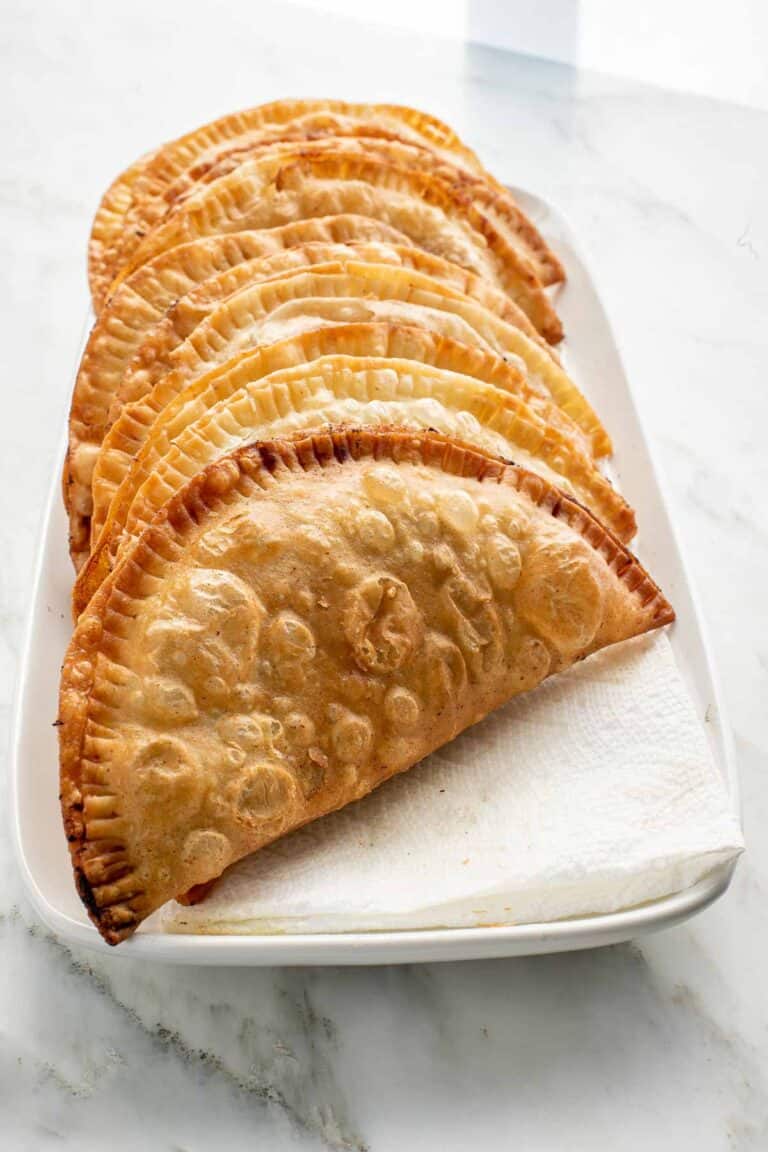
Why you’ll Love this Quick Chebureki Recipe
All the crunch of a cheburek from a street stall, and you never touch a rolling pin.
- Beef that stays juicy – the filling goes in soft and a little wet, so the beef steams in its own pocket while the shell fries.
- A shell that crackles – raw tortillas puff into blisters in hot oil and shatter when you bite in, the way homemade cheburek dough does.
- Tortillas instead of dough – they come rolled thin and ready, so there’s no kneading and no hour of resting.
- A dozen in under an hour – about 15 minutes to fill and fold, then 6 minutes a pan, two at a time.
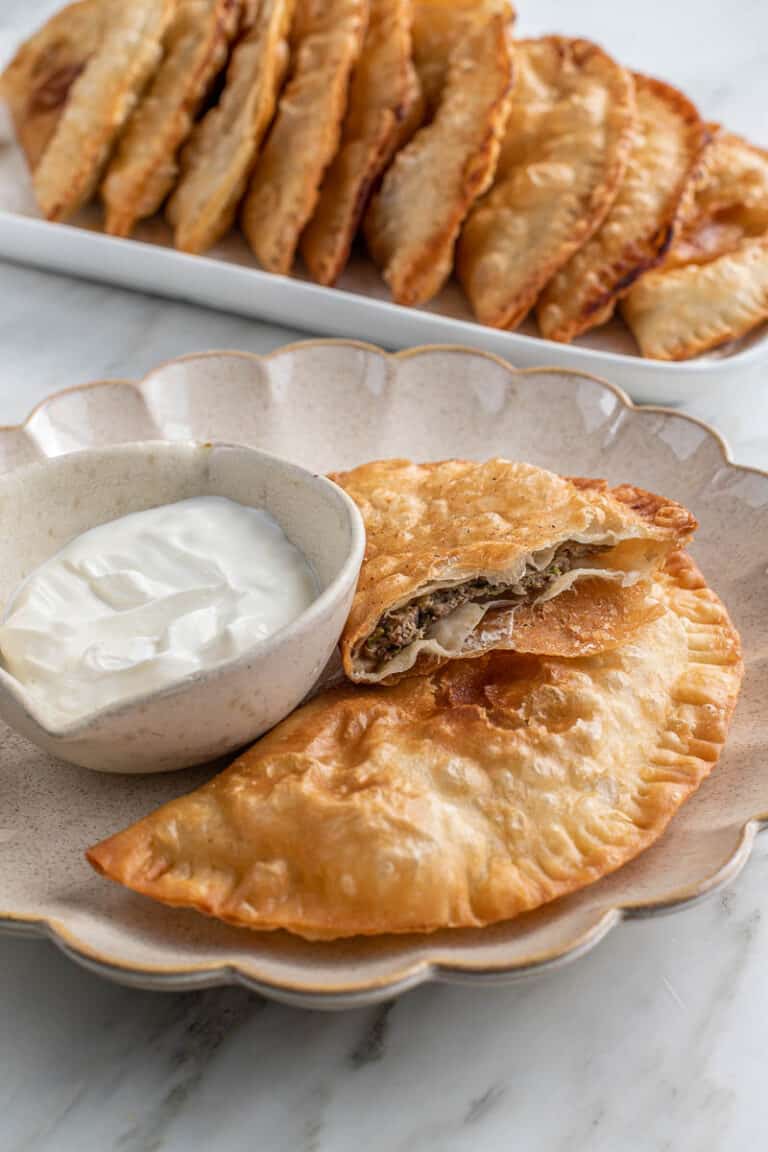
What Are Chebureki?
Chebureki (one is a cheburek, said che-boo-rek) are half-moon fried pies from Crimean Tatar cooking. A thin, unleavened dough of flour, water, and a little fat wraps a thin layer of ground meat and a lot of onion, and each one fries until the shell bubbles up and turns golden.
From Crimea they spread across Ukraine, the Caucasus, and Central Asia. That’s why you’ll see them spelled çiberek, chebureky, or cebureki, and why so many menus in the US call them Russian meat pies.
Quick Chebureki with Tortillas
My recipe is adapted from the authentic version, the way our family likes it best. We use beef instead of lamb, and raw flour tortillas instead of homemade dough.
It works because tortilla dough and cheburek dough are made from the same few things: flour, water, and a little fat. The difference doesn’t show up in the taste test, and you skip the mixing, kneading, rolling, and resting.
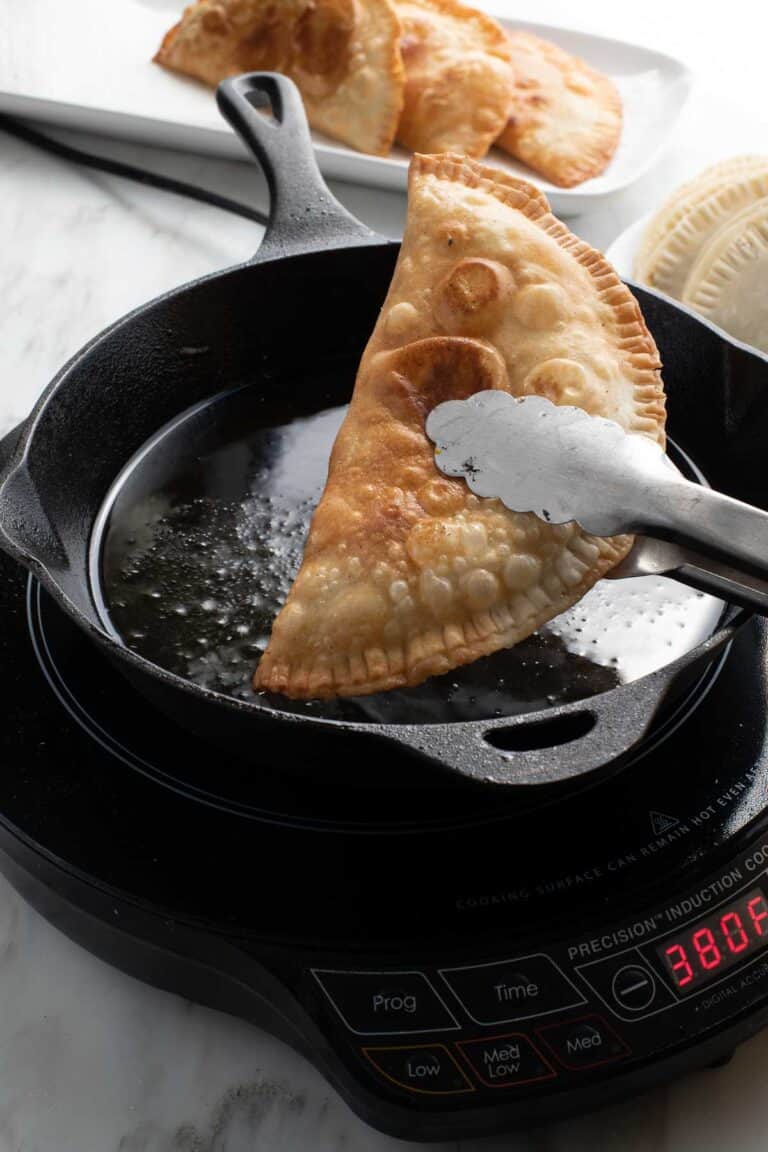
Chebureki Ingredients
Beef, onion, fresh herbs, and raw tortillas, plus salt, pepper, and water. The onion and the water are the two that keep the filling juicy. Amounts are in the recipe card at the bottom.
Chebureki Filling
Everything for the meat filling goes into one bowl.
- Ground beef chuck: 80/20 is best, because the fat melts into the onion juice and keeps the filling moist. Lamb is traditional, and pork or a beef and pork mix works too.
- Yellow onions: Onion juice is a big part of the moisture in the filling, and the onion turns sweet as it steams inside the shell. White onions work too.
- Fresh herbs: Parsley, dill, cilantro, or a mix. Fresh herbs stay green and bright in the filling; dried ones taste dusty.
- Water: It sounds odd in a meat filling, but it matters. The water turns to steam inside the sealed pocket, keeping the beef juicy and puffing the shell into bubbles.
- Kosher salt: I use Morton, and the amount in the card is measured for it. Salt also pulls extra juice out of the onion, so the filling gets wetter as it sits.
- Black pepper: It’s the only spice in the filling, so grind it fresh if you can.
Chebureki Shell
The tortillas are why this version is quick.
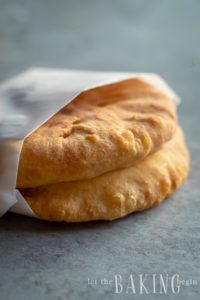
- Raw flour tortillas: Look for the uncooked kind in the refrigerated case, 8 to 9 inches across (mine are Tortilla Land). Cooked tortillas won’t stretch, seal, or blister, so they can’t stand in here.
Any raw tortillas left over? They make my apricot cream cheese chimichangas too.
Oil for Frying Chebureki
You need enough oil to come about an inch up the sides of the skillet.
- Neutral oil: Light olive, avocado, vegetable, canola, or peanut oil, anything with a high smoke point. Extra virgin olive oil and butter burn before the pan gets hot enough.
How to Make Chebureki (Step by Step, With Video)
Mix the filling, then fill and seal all of them before you heat the oil, so the frying goes fast. Watch the video at the bottom if you’d like to see the fold and the fry.
How to Make the Chebureki Filling
Grate the onions right into the bowl so you keep every drop of juice.
- Grate the onions – on the fine side of a box grater, right into a large bowl.
Can I chop the onions instead?
Chop them as fine as you can, or pulse them in a food processor. Bigger pieces hold on to their juice, and the filling comes out drier. If you have a meat grinder, you can run the onions through it with the beef. - Mix the filling – add the beef, herbs, salt, and pepper to the onions and mix well.
Can I use ground chicken or turkey?
Yes. Chicken, turkey, and pork all work. Pick dark meat or a higher-fat grind if you can, since lean poultry fries up drier than beef. - Work in the water – add it a little at a time and mix until the meat soaks it up and the filling is very soft.
It looks too wet. Is that right?
Yes. It should be soft and spreadable, like a thick paste. Keep mixing until no water pools at the bottom of the bowl, because loose water runs out the seam instead of staying in the pocket.
How to Shape Chebureki
Take the tortillas out of the fridge about 20 minutes before you start, so they fold without cracking.
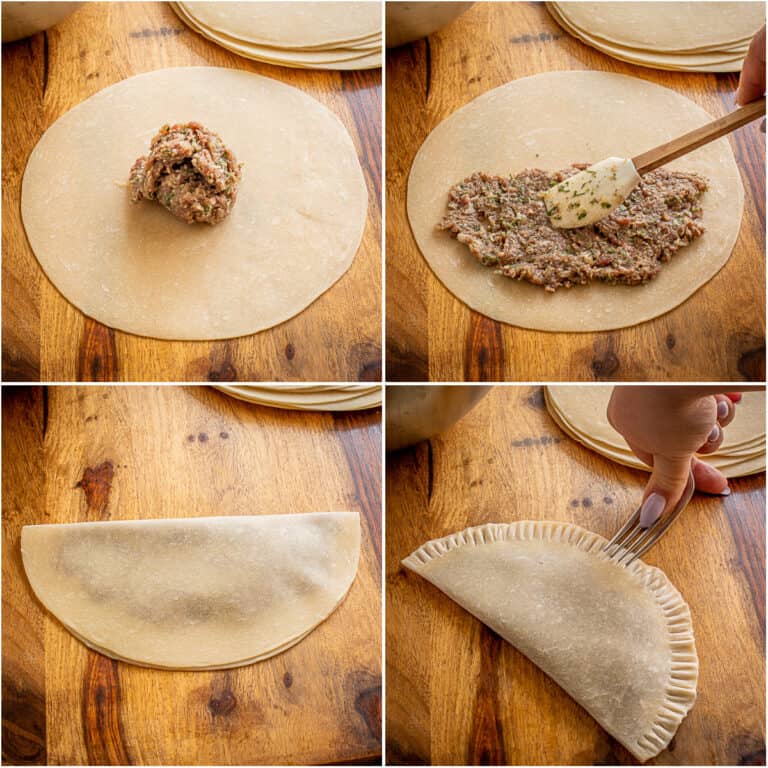
- Spread the filling – in a thin, even layer over one half of a tortilla, leaving a 1/2-inch border.
How much filling goes in each one?
About 1/4 cup. Spread it thin rather than piling it up, because a thin layer cooks through in the few minutes it takes the shell to brown. - Fold and press – fold the empty half over and pat it flat from the fold toward the edge to push out the air.
My tortilla tore. Can I fix it?
Pinch the dough back together and press that spot extra firmly when you crimp. Tears usually mean the tortillas are still cold, so give the rest a few more minutes on the counter. - Seal with a fork – press the edges together and crimp all the way around.
Do I really need the fork?
Yes. The fork presses the two layers of dough into each other, so the seam holds in the hot oil. Your fingers alone leave soft spots that can open up.
How to Fry Chebureki
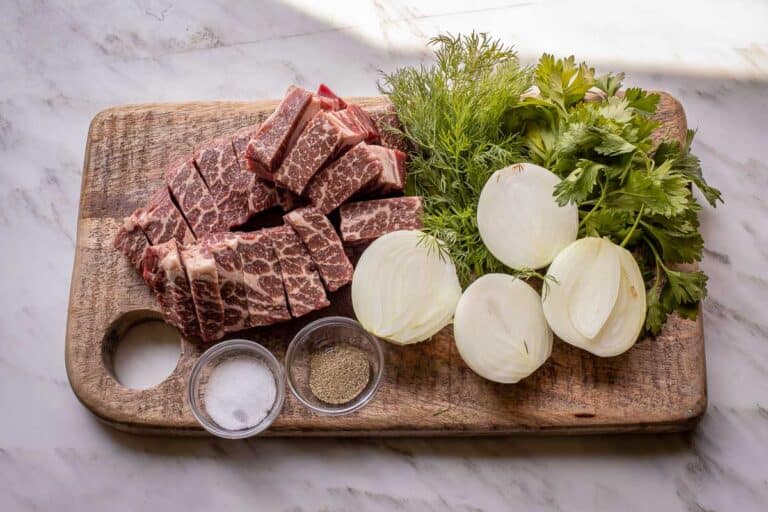
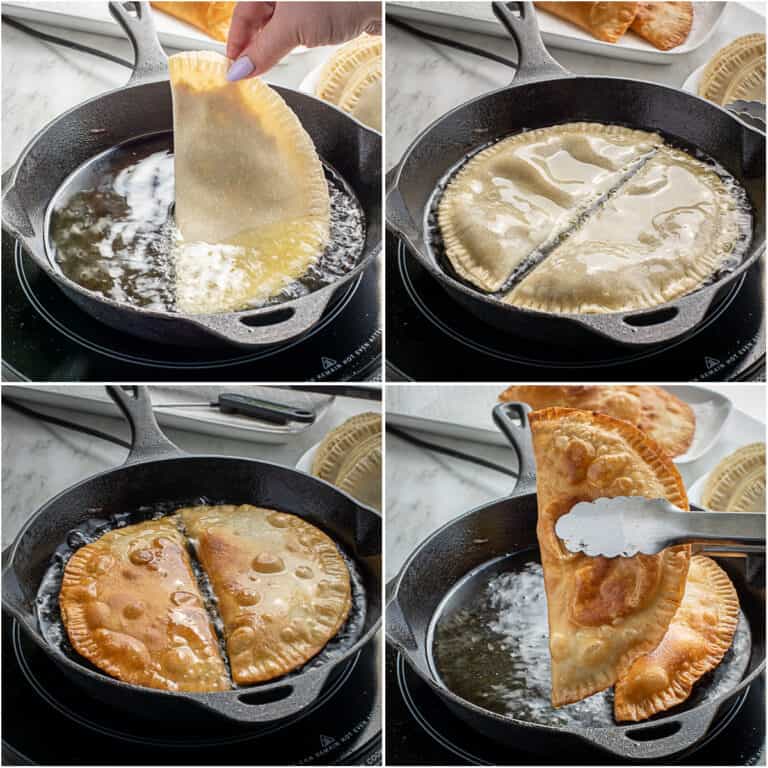
A heavy 10-inch skillet fits two chebureki side by side, straight edges facing each other.
- Heat the oil – about 1 inch deep in a heavy skillet, to 350°F (175°C) over medium heat.
Do I need a thermometer?
It’s the easiest way to get crisp chebureki instead of greasy ones. A clip-on or instant-read thermometer tells you when the oil is ready, and when it drifts too hot or too cool.Which pan works best?
A heavy one. Cast iron, like the skillet in my photos, holds its heat when cold chebureki go in. A thin pan cools off fast, and the chebureki soak up oil while it recovers. - Fry two at a time – turning once, until both sides are golden and bubbly.
The shell is dark. Is the meat cooked?
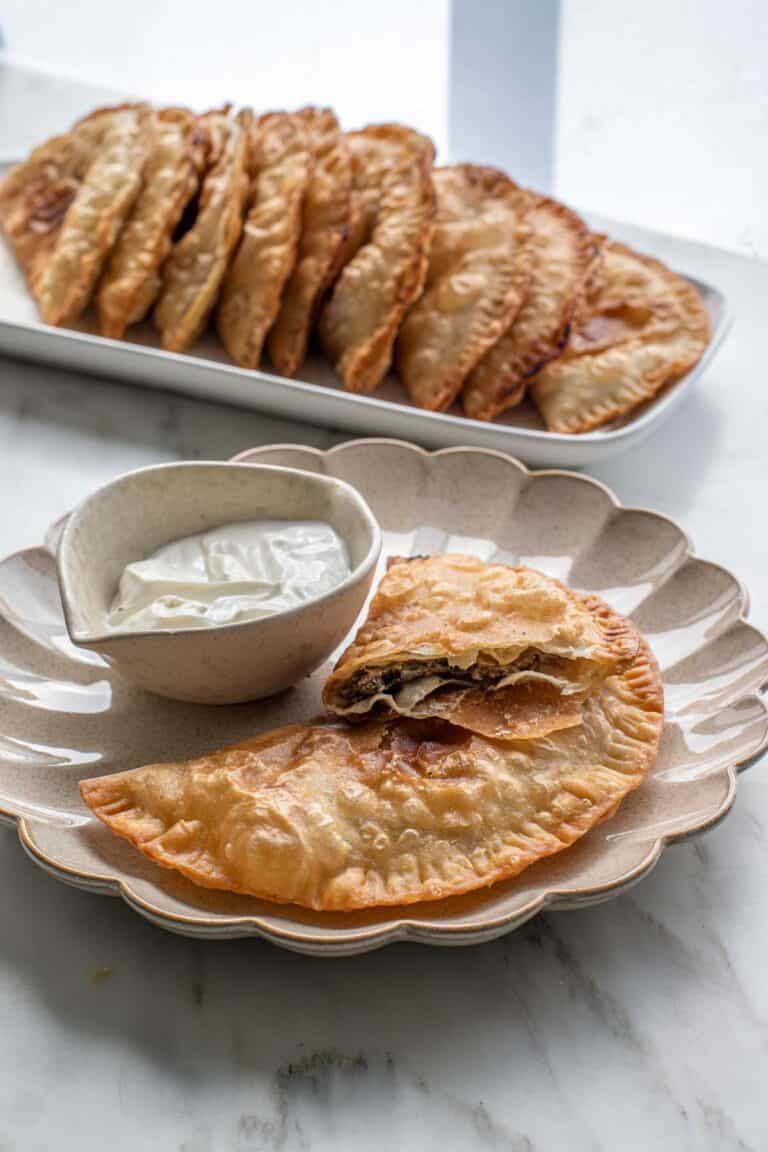
If the shell browns in under 2 minutes, the oil is too hot, so turn the burner down. With a thin layer of filling and the oil between 350°F and 375°F (175°C and 190°C), the beef cooks through by the time both sides are golden. - Drain and serve – on a wire rack or paper towels, and serve hot with sour cream, Greek yogurt, or tzatziki sauce.
How do I keep them warm while I fry the rest?
Set the wire rack on a sheet pan in a 200°F (95°C) oven while you fry the rest. Keep them uncovered, because a lid or foil traps steam and softens the shell.
Marina’s Pro Tips for theBest Chebureki

Read these once before the oil goes on the stove.
- Keep the chebureki filling soft, not firm. A soft, wet filling turns to steam inside the sealed shell. That steam keeps the beef juicy and lifts the shell into bubbles, while a dry filling fries up flat and tough.
- Pat every cheburek flat before crimping. Trapped air expands in the hot oil and pops the seam open. Work from the fold toward the edge so the air has a way out.
- Keep the frying oil between 350°F and 375°F. Cooler oil soaks into the shell and makes it greasy. Hotter oil browns the shell before the meat inside is cooked.
- Fry two chebureki at a time, not a full pan. Every cold cheburek pulls the oil temperature down. Two per batch lets the oil stay hot, and each pair takes only about 6 minutes.
- Drain fried chebureki on a rack, not a plate. On a plate, steam gets trapped underneath and softens the bottom. A rack lets the air move all around, so they stay crisp.
What to Serve with Chebureki
Chebureki are street food, eaten hot out of hand. At the table, something cool and sharp on the side balances all that crunch.
- Creamy dips: sour cream, full-fat Greek yogurt, or my tzatziki sauce.
- Pickles: Dad’s extra crunchy fermented pickles or spicy Korean carrots cut right through the richness.
- Fresh salad: this cucumber salad with dill and garlic is ready in minutes.
- Soup: serve them with Ukrainian borsch in place of bread.
How to Make Chebureki Ahead
Mix the filling up to a day ahead and keep it covered in the fridge. It looks wetter the next day, because the salt keeps pulling juice from the onion, so stir it before you use it.
How to Store Chebureki
Room temperature: Best within an hour of frying. Leave them uncovered on a rack so they don’t steam themselves soft.
Fridge: Once cool, up to 3 days in an airtight container.
Freezer: Freeze fried and cooled chebureki flat on a tray, then move them to a freezer bag, for up to 2 months.
To reheat: Bake at 375°F (190°C) in the oven or air fryer for 5 to 8 minutes, until hot and crisp again, adding a few minutes if they’re frozen. The microwave makes the shell soggy.
Quick answers before you start frying.
Chebureki FAQ
Why Are My Chebureki Greasy?
The oil was too cool. Below 350°F the shell soaks up oil instead of crisping, and a crowded pan drops the temperature fast. Fry two at a time and let the oil heat back up between batches.
Can I Use Cooked Tortillas for Chebureki?
No. Only raw, uncooked flour tortillas work. Cooked tortillas are already set, so they crack at the fold, don’t seal well, and never puff into bubbles in the oil.
What Is the Difference Between Chebureki and Empanadas?
Both are half-moon meat turnovers. Chebureki use a very thin, unleavened dough and a raw meat filling that cooks inside the shell, and they’re always fried. Empanadas usually have a sturdier pastry and a filling that’s cooked first, and they can be baked or fried.
Can I Bake or Air Fry Chebureki?
You can, but they won’t be the same. Only hot oil puffs the shell into those crackly bubbles, so a baked or air-fried cheburek comes out smooth and drier, closer to a hand pie. For the real texture, fry them.
What Is the Difference Between a Cheburek and a Burek?
A burek is a Balkan pastry made from layers of thin, flaky dough, usually baked and filled with meat, cheese, or spinach. A cheburek is a single thin sheet of dough folded over a meat filling and fried until it bubbles.
Are Chebureki Russian, Ukrainian, or Tatar?
Chebureki come from Crimean Tatar cooking. They became everyday food across Ukraine, Russia, the Caucasus, and Central Asia, which is why you’ll often find them sold as Russian meat pies.
How Many Calories Are in a Cheburek?
About 290 calories per cheburek made with this recipe, including roughly 1 teaspoon of oil each one absorbs while frying. The full nutrition is in the recipe card.
More Slavic Comfort Food to Try
If these chebureki disappear fast at your house, these four are good ones to try next.
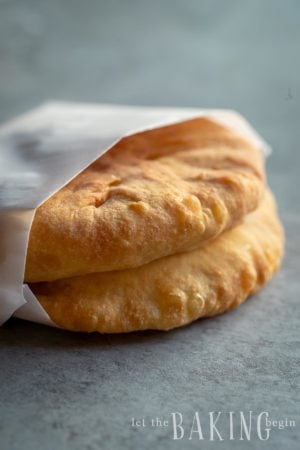
No-Yeast Piroshky
No yeast and no rising, with a potato filling. Another fast fix for a fried pie craving. →
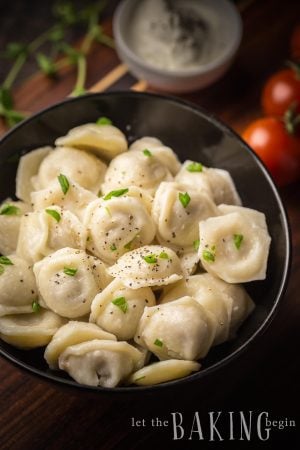
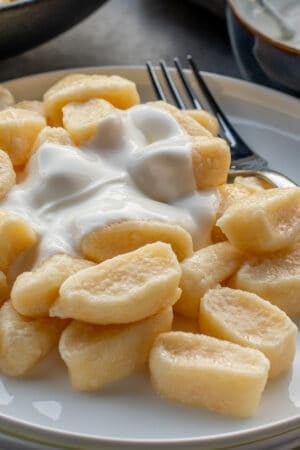
Lazy Pierogi
Sweet farmer’s cheese dumplings with the dough and filling mixed as one, ready in 30 minutes. →
Watch Marina Make This Quick Chebureki Recipe
Made these chebureki?
Please leave a ⭐⭐⭐⭐⭐ star rating and a comment below.
It helps other readers find the recipe, and I read every single one.
Quick Chebureki Recipe with Tortillas
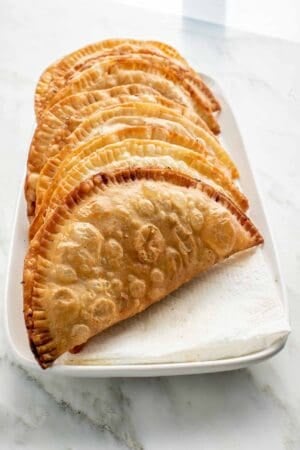
Chebureki with a crackly, bubbly shell and a juicy beef and onion filling. Raw flour tortillas stand in for the dough, so there's nothing to knead or rest.
Ingredients
Chebureki Filling
- 1 lb (454 g) ground beef chuck 80/20 (Note 2)
- 2 large yellow onions grated
- 1/4 cup (15 g) fresh herbs (parsley, dill, or cilantro) chopped
- 1/4 cup (60 ml) water
- 1 1/2 tsp (7 g) kosher salt Morton
- 1 tsp (2 g) black pepper freshly ground
Chebureki Shell
- 12 raw flour tortillas uncooked, 8 to 9 inches (Note 1)
Oil for Frying Chebureki
- 2 cups (480 ml) neutral oil (light olive, avocado, or vegetable) enough to come 1 inch up the pan (Note 3)
Instructions
Chebureki Filling
-
Grate the onions. Grate 2 large yellow onions on the fine side of a box grater into a large bowl, juice and all.
-
Mix the filling. Add 1 lb ground beef chuck, 1/4 cup fresh herbs (parsley, dill, or cilantro), 1 1/2 tsp kosher salt, and 1 tsp black pepper, and mix well.
-
Work in the water. Add 1/4 cup water a little at a time, mixing until the meat soaks it up and the filling is very soft, like a thick paste.
Shape the Chebureki
-
Spread the filling. Spread about 1/4 cup of filling in a thin, even layer over one half of a raw tortilla, leaving a 1/2-inch border. (See post above for photo tutorial.)
-
Fold and press. Fold the empty half over into a half-moon and pat it flat from the fold toward the edge to push out any air.
-
Seal with a fork. Press the edges together, then crimp all the way around with a fork so the filling stays inside while frying. Repeat with the rest of the tortillas.
Fry the Chebureki
-
Heat the oil. Pour 2 cups neutral oil (light olive, avocado, or vegetable) into a heavy 10-inch skillet so it comes about 1 inch up the sides. Heat over medium to 350°F (175°C).
-
Fry two at a time. Fry 2 1/2 to 3 minutes per side, until golden and bubbly. Keep the oil between 350°F and 375°F (175°C and 190°C); cooler oil makes them greasy.
-
Drain and serve. Drain on a wire rack or paper towels and serve hot with sour cream, Greek yogurt, or tzatziki sauce.
Recipe Notes
- Tortillas: Use raw, uncooked flour tortillas from the refrigerated case, 8 to 9 inches across. Cooked tortillas crack and won't seal. Let them sit out for 20 minutes so they fold without tearing.
- Meat: 80/20 beef chuck keeps the filling juicy. Ground lamb is traditional, and pork, chicken, or turkey work too.
- Oil: Use any neutral oil with a high smoke point. Each cheburek absorbs about 1 teaspoon of oil while frying, and that's counted in the calories.
- Pan: A heavy 10-inch skillet fits two chebureki side by side, straight edges facing each other.
- Make ahead: Mix the filling up to 1 day ahead and refrigerate. Stir before using.
- Storage: Refrigerate cooled chebureki up to 3 days or freeze up to 2 months. Reheat at 375°F (190°C) in the oven or air fryer for 5 to 8 minutes.

Thank you for following me on Instagram, Facebook & Pinterest!
Hashtag your photos #LetTheBakingBeginBlog so I can see your creations and for a chance to be featured!
I first shared this quick chebureki recipe in 2012 and reshot the photos and video in 2023. In September 2026 I rewrote the steps, added tips for sealing and frying, and put metric measurements in the recipe card.
Marina | Let the Baking Begin













Absolutely a staple in our household. I make these in big batches and freeze them without frying. Then pull them out into the fridge the day before to let them thaw and fry them as usual. Crispy, delicious and tastes like childhood!
Great recipe! Thank you darling!
I think peanut oil will be more fragrant when cooking. I like fried chicken meatballs.
The pictures look great, but I can’t find your tortilla recipe which makes this recipe useless. Everyone knows how to make a filling and it’s also very hard to get it wrong, the dough is always the tricky and difficult part so every chebureki recipe should focus mostly on dough with precise measurements and deep frying instructions.
Darling, she used raw tortillas. It says it under the ingredients AND she also provided a PICTURE of the package. Hope this helps!
Marina I just wanted to say thanks! This recipe is one of our family favorite, I like to make a big batch and then warm them in the air fryer the next day. They taste like they just came off the frying pan! I appreciate the time you put into making these recipes may God bless you and your family!
Thank you so much, Luba for your feedback! I appreciate it! May God bless you too!
Chebureki is not Russian nor is it Ukrainian. It is a traditional Crimean Tatar dish. Please stop the spread of false information. Name of the dish alone tells you it’s not Russian nor Ukrainian.
Hi Eldar, nowhere in the recipe does it say that these Chebureki are Russian or Ukrainian. It does mention that Chebureki is Russian and Ukrainian street food. But you’re right that the recipe itself has Crimean Tatar origins.
On this website, I share my family recipes and since I’m Ukrainian, I’m including details of what I know from my own personal experience.
Literally the first line of this web page says ‘Chebureki is a delicious Russian street food’. Unbelievable. Although I have to say – this has nothing to do with Crimean Tatar cuisine. Tortillas? Please.
Do the decent thing and change the name of whatever it is you’re cooking to anything but Chebureki. Crimean Tatar culture is dying and this kind of behaviour is part of the reason.
So I subjected my family to this last night. Sort of. It was a pastiche of this recipe and the one in our ancient Soviet cookbook. Ground lamb ( one pound ) , onion, garlic, salt, pepper, and a bit of brown rice.( 2 ounces ).
I did use the raw tortillas…what a timesaver! Didn’t want really huge chebureki, so I cut down the folded tortillas a bit. Painted the edges with egg and sealed them with a fork. Then I sprayed them lightly with olive oil and stuck them in the air fryer for 6 minutes at 350. Just two at a time.
I was worried that the filling might not be fully cooked so I stuck an instant read thermometer in a couple of them. Temp was 200 degrees internal.
The crust came out nice – not quite the traditional deep fried goodness, but very edible. It puffed way out – the layers of tortilla separated and air between them. A satisfying crunch with meaty goodness in the middle. Messy – when you got near the bottom, they would *squirt*.
It’s great to know that this comes out well in the air fryer! Thank you for sharing your experience, now if someone asks me if they can make it in the air fryer I’ll direct them to your comment 😀
I look forward to trying this, after I lose the weight I need to lose. The raw tortillas are a genius move. I’d like to try it in my air fryer.
I just looked up chebureki in my go-to resource for such things – my wife’s “Book of Tasty & Healthy Food” ( книга о вкусной и здоровой пище ). Those guys went for the gold – ground sheep flesh and sheep fat.
Might try it with ground lamb, for that real “Moscow street vendor” flavor.
Great plan, Jerryk!
Very good and easy enough for my husband to make. He
He did use some shredded cheddar cheese sprinkled on top of the filling before folding an sealing, (with an egg white beaten with a little water and brushed on the inside edges as “glue”). Very easy. Very yummy, he’ll make them for the kid’s sleep over; they’ll love it!
Hey Marina, it’s not a Russian dish it’s a Crimean Tatar dish and definitely not street food (at least for us??) please stop spreading wrong information
Hi Zeynep,
Sounds like they just didn’t sell Chebureki out on the streets where you’re from 🙂 We had babushkas sell these at markets very often.
As to the origins, you’re right it originated in Crimea but was consumed all throughout Eastern Europe, including Russia, Ukraine, Romania, Turkey, and Central Asia.
Thank you for your comment!
thank you marina for this tasty recipe….i love the taste, but mine seem to cracking at the seams..two tortillas are pretty dry so I would expect that they will crack and split into two…is there a way to fill or moisten it so it does not crack?
oh i know why!!..I used corn tortillas instead of flour tortillas 🙁
Oh no! Try using flour tortillas, they come out so good!
Hi Snowflakes,
it sounds like your tortillas are on the dry side to begin with. If you start with more fresh tortillas you shouldn’t have any cracking.
Hey Marina, I’ve made this and it was great ( although I over cooked some of them a tad)… but my wife said she thought it would be good with cheddar or Gouda cooked in.
How “unauthentic” would that be, out of curiosity?
-Jack
Hey Watera,
Adding cheddar or any kind of cheese would be super unauthentic, but who cares ? I think it would taste good, so give it a try!
I have a question. We too have done a fundraiser in our church with these. Yes, I made 350 of them also. I am wondering what your parents experience is. Do they need to be fried right before they are sold or can they be fried a day in advance and reheated in the oven to be sold? Which way did they do it and their reasons? My understanding is they need to be crunchy and if done in advance they will become soft. I am in disagreement over it with my own mom, so I need some input.
Hi Lily,
My parents always fry them in the church kitchen closer to the end of the service, so they retain their freshness and crispiness. This is not the kind of food that you can do in advance. Even 30 minutes after they are fried they are not as crispy as they are right after they’re fried, but next day they would not be good at all. Hope you and your mom can come to a common solution on this one 🙂 Good luck 🙂
Awesome recipe. I love the fact that there are no onions in the filling. One question though, on what temp. do I fry them?
Thanks Tania! You should fry them at 350F