
Easy Mango Sago Dessert Recipe (Video)
Mango Sago is a chilled, no-bake dessert made with chewy tapioca pearls suspended in a sweet mango-and-coconut base, with fresh mango cubes stirred through at the last minute. It tastes like cold mango cream with something to chew on; it is barely cooked, and you make the whole thing in a blender and a saucepan. Every bite has three textures at once, which is why people go back for a second cup.
If you like a spoonable dessert that sets in the fridge instead of the oven, you will probably also want my passion fruit panna cotta, my no-bake tiramisu, and my 4 ingredient creme brulee.

We first tried this dessert at an Asian restaurant in Las Vegas, and it was love at first bite. I had never had anything like it, so I had no idea what to expect from that first spoonful. It was cold, creamy, and lightly sweet, loaded with juicy mango, and I knew right then it wouldn’t be the last time I ate mango sago.
Here’s why you’ll Love this mango sago
This is the dessert I make when it is hot, when I have people coming, or when good mangoes show up at the store. Here is what it has going for it.
- No oven, no baking – you boil tapioca pearls and run a blender. That is the whole skill list.
- Three textures in one spoon – chewy sago, popping mango boba, soft cubes of fresh fruit in a creamy base.
- You control the sweetness – the sweetened condensed milk goes in by taste, so ripe sweet mangoes mean you use less.
- Built for a crowd – it scales, it chills in one big bowl, and you can portion it into cups an hour before people arrive.
- Forgiving – if it thickens too much in the fridge, you thin it back out. Nothing is ruined.
How’s this mango sago different?
Most versions stop at sago, mango, and coconut milk. Mine adds two non-traditional things and one habit that saves the batch later.
- Mango popping boba goes in – the little spheres burst and give a second, brighter hit of mango against the creamy base.
- Coconut agar jelly goes in – soft cubes that are firmer than the sago and give the spoon something else to find.
- Save the drained syrup – the liquid you pour off the boba and jelly goes in the fridge, and it is what you use to loosen the sago after it stiffens overnight. Water would dilute the flavor. That syrup will not.
- Half the mango is blended, half is cubed – blended mango makes the base taste like mango instead of sweetened coconut milk, and the cubes keep it from feeling like pudding.

Ingredients for mango sago
Short list, and each item does a specific job. Amounts are in the recipe card at the bottom, so here is what each one brings and what you can swap.
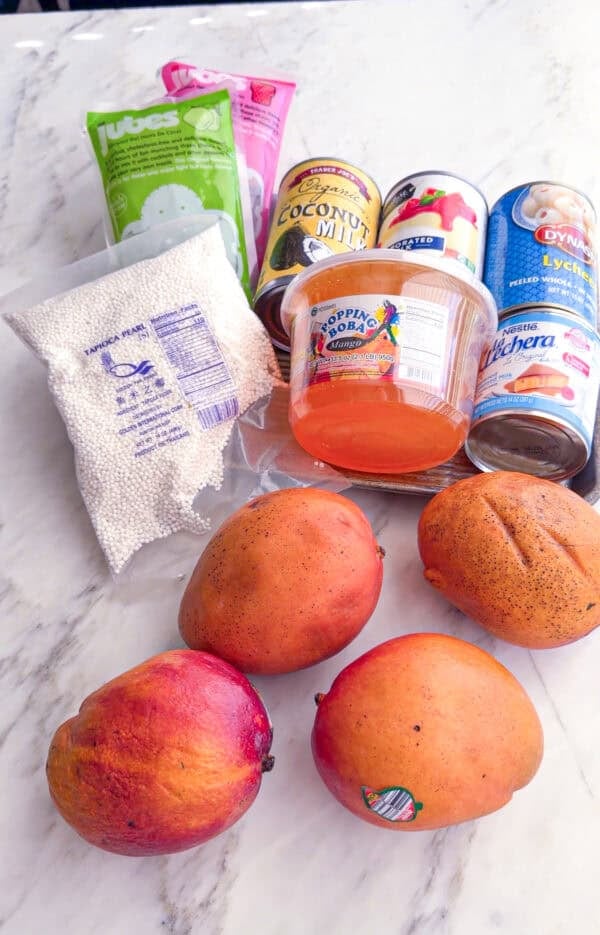
- Small tapioca pearls (sago) give the chew. Buy the small ones, not the big black boba pearls sold for bubble tea, because the large ones cook on a completely different schedule and stay hard in the center in this recipe. Quick-cooking pearls exist too, and those follow their own package timing.
- Mangoes are the flavor and most of the sweetness. Champagne mangoes (also sold as Ataulfo or honey mangoes) are my first pick because they are sweet and almost fiber-free. Any ripe sweet mango works. Frozen mango chunks are fine for the blended base, and they blend smoother than a slightly underripe fresh one.
- Coconut milk carries the richness and the coconut note. Use full-fat canned coconut milk, and shake or stir the can first because the fat separates. Evaporated milk is the other classic choice, and it is what I used in the video. Coconut milk tastes tropical; evaporated milk tastes more like a milk pudding. Both are right.
- Sweetened condensed milk sweetens and thickens at the same time. Add it to taste rather than dumping it all in, since ripe mangoes bring a lot of sugar on their own.
- Mango popping boba is optional and not traditional. It adds the burst of juice. Any complementary flavor works. Keep it cold until you use it.
- Coconut agar jelly is also optional and not traditional. It adds firm little cubes. Lychee or passion fruit jelly is a good stand-in.
How to make mango sago (step by step)
Five steps, and the only one that needs your attention is the first. Cook the pearls until there is no crunch left, and then stir.
- Cook the tapioca pearls into sago
- Bring the water to a rolling boil, then slowly pour in the pearls while stirring. Pearls dropped into water that isn’t boiling sink to the bottom and stick together in one lump.
Keep them at a simmer and stir from time to time so nothing sticks to the bottom, until they are almost fully translucent.
If there is still a white dot in the middle, turn off the heat, put the lid on, and let them sit for another 10 minutes. Residual heat finishes the centers without turning the outsides to mush.

- Bring the water to a rolling boil, then slowly pour in the pearls while stirring. Pearls dropped into water that isn’t boiling sink to the bottom and stick together in one lump.
- Rinse the sago and get it ready to combine
- Drain through a sieve and rinse under cold running water until the water runs clear. That washes off the loose surface starch, which is exactly what makes cooked pearls clump into one solid mass.
- Don’t leave them sitting in water. Sago keeps drinking up whatever it’s in, and you want it soaking up that mango base, not plain water.
- Have the base blended and ready so the pearls go straight in.
- Blend the mango coconut base
- Add the coconut milk or evaporated milk, mango, and sweetened condensed milk to a blender.
- Blend until completely smooth, with no fiber left. If your mangoes are stringy, push the puree through a fine mesh sieve.
- Taste it now and adjust the condensed milk. This is the only easy moment to fix the sweetness.
- Keep the base cold while the sago finishes.
- Combine everything while the sago is fresh
- Drain the coconut jelly and the mango popping boba, and save that syrup in the fridge. You will want it tomorrow.
- In a large bowl, stir together the drained sago, mango coconut base, jelly, and boba.
- Stir gently until it is even. It will look loose right now, and that is correct, because the pearls keep drinking liquid as it chills.
- Chill, then finish with fresh mango
- Cover and refrigerate for about 3 hours, until it is cold all the way through. This is not optional. It is a dairy and coconut dessert, and it belongs in the fridge.
- Stir before serving, and thin it with the reserved syrup if it has tightened up.
- Peel and cube the fresh mangoes right before serving, then either fold them in or layer them with the sago in cups.



Marina’s Pro Tips for theBest Mango Sago

- Use a bigger pot of water than you think you need. Tapioca pearls need room to move. Crowded pearls knock into each other, shed starch fast and set into a block.
- Never add the pearls before the water is at a hard boil. The outside of a pearl needs to seize immediately. In lukewarm water it dissolves instead, which is where the glue comes from.
- Finish the centers off the heat. A white dot at the 20 minute mark does not mean boil harder. Lid on, heat off, ten minutes. Boiling longer just blows out the outsides while the middles stay chalky.
- Rinse the cooked pearls until the water runs clear. That rinse is the single step that separates loose pearls from one sticky lump, and most people cut it short.
- Taste the base before the pearls go in. Mango sweetness swings wildly between fruit. Once everything is combined you cannot correct it without throwing the texture off.
- Hold back the fresh mango cubes. Cubes stirred in early go soft and start weeping juice into the base. They go in at the last minute, every time.
- Keep the drained jelly and boba syrup. Sago keeps absorbing liquid overnight, so a batch that was perfect yesterday is stiff today. That syrup loosens it back without watering down the mango.
Ways to serve mango sago
It is good plain and cold in a bowl, but it moves easily into other formats.
- Layered in clear cups – alternate the sago mixture with fresh mango cubes so the layers show. This is how I serve it to guests.
- As a drink – thin it with extra coconut milk until it pours, then serve over ice with a wide straw.
- With a scoop of ice cream – coconut or mango, dropped right on top.
- Finished with texture – toasted coconut flakes, a spoonful of extra popping boba, or a few pomegranate seeds.
- On a dessert table – it sits well next to a set custard, so I often put it out with my panna cotta with strawberry sauce for people who want something less tropical.

Serve it really cold, with extra mango spooned over the top.

Make It Ahead
This one is better made ahead, and it travels well if you plan for it.
- A day ahead: make the sago and the mango coconut base, combine them, and keep the bowl covered in the fridge.
- Hold the fresh mango. Cubes go on right before it reaches the table, or they weep and thin the base.
- It thickens overnight. Stir in the reserved jelly and boba syrup a spoonful at a time until it loosens up again.
- Taking it somewhere: carry it in a cooler with ice packs and portion into cups once you arrive.
- Keep total time out of the fridge under 2 hours.
How to store mango sago
- Room temperature: this one does not sit out. It is a dairy and coconut dessert, so serve it cold and get leftovers back into the fridge within 2 hours, or within 1 hour if the room is above 90F.
- Refrigerator: airtight, up to 2 days. The sago keeps drinking liquid, so stir it and loosen it with the reserved jelly syrup before you serve it again.
- Freezer: do not. Tapioca pearls come out of the freezer hard and grainy and they never come back.
- Fresh mango: cube it fresh each time you serve rather than storing it in the mixture, where it goes soft and waters the base down.
Straight from the fridge, this is what you’re going for.
Mango Sago FAQ
Why are my tapioca pearls still chalky in the middle?
They came off the heat too early, or the pot was too crowded. Do not boil them harder to fix it. Turn the heat off, cover the pot and let them sit in the hot water for another 10 minutes. The centers finish gently and the outsides stay intact. If they are still chalky after that, they were quick cooking pearls that got the long treatment, or large boba pearls sold for bubble tea, which need a much longer cook than this recipe gives them.
My sago turned into one gluey clump. What went wrong?
Almost always one of three things. The pearls went into water that was not at a full rolling boil, so they dissolved instead of setting. Or there was not enough water for them to move around in. Or they did not get rinsed properly after draining, and the loose starch on the outside cemented them together as they cooled. Rinse under cold running water until the water runs clear, then hold them in a bowl of cold water until you need them.
It went thick and stiff in the fridge overnight. Can I save it?
Yes, and this is normal rather than a mistake. Sago keeps absorbing liquid for hours after it is mixed in. Stir in the syrup you drained off the coconut jelly and popping boba, a spoonful at a time, until it loosens back to the consistency you want. Coconut milk or evaporated milk also works. Plain water does the job too but it dulls the mango flavor, so save that for a last resort.
What is sago, and is it the same thing as tapioca?
Not technically, though they are used interchangeably. True sago is a starch from the pith of tropical palm trees. Tapioca pearls are made from cassava root starch. They look the same, cook the same way and have the same chew, and most bags sold in North American stores as sago are actually tapioca. Either one works here. Neither has any flavor of its own, which is the point, since it takes on the mango and coconut around it.
Which mangoes are best, and how do I ripen a hard one?
Champagne mangoes, sold as Ataulfo or honey mangoes, are the ones I reach for. They are small, deep yellow, very sweet and have almost no fiber, so the base blends silky. Carabao mangoes are excellent if you can find them. The common red and green Tommy Atkins mango works but tends to be stringier, so strain the puree. To ripen a hard mango, leave it on the counter in a paper bag for a day or two. It is ready when it gives slightly to a gentle press near the stem and smells sweet there. The fridge stops ripening, so only chill it once it is ready.
Coconut milk or evaporated milk, which should I use?
Both are traditional in different places, and they make two different desserts. Full fat coconut milk makes it richer and unmistakably tropical, and it is the version I photographed. Evaporated milk is lighter and cleaner and lets the mango come forward, and it is what I use in the video. Use whichever one you like more, and use full fat either way, since low fat versions make the base taste thin.
Can I make mango sago dairy free or vegan?
Yes. Use full fat coconut milk instead of evaporated milk, and replace the sweetened condensed milk with either sweetened condensed coconut milk or a simple syrup made from sugar and water, sweetening to taste. Simple syrup does not thicken the way condensed milk does, so the base will be looser. Reduce the coconut milk slightly to compensate. Check the coconut jelly and the popping boba labels as well, since some brands contain gelatin.
Can I use frozen mango?
For the blended base, yes, and it is often the better choice. Frozen mango is picked ripe and blends smooth, while a rushed fresh mango can be fibrous and sour. Thaw it first so it does not seize the base into a slush. For the cubes stirred in at the end you want fresh, because thawed chunks are soft and release water. Frozen mango is usually less sweet than a ripe fresh one, so taste before you finish adding the condensed milk.
What is mango pomelo sago?
It is the Hong Kong dessert this whole family of recipes comes from, and the difference is the pomelo. You separate the juice sacs from a pomelo and fold them in at the end, so you get little bursts of citrus that cut the sweetness. If you want to try it, add about a cup of pomelo sacs at the same point where the fresh mango cubes go in. Ruby grapefruit is the usual substitute, though it is more bitter, so go lighter with it.
Can I skip the popping boba and the coconut jelly?
Yes. Neither one is traditional, and the dessert is still very good with just sago, mango and the coconut base. What you give up is contrast, since the boba bursts and the jelly is firmer than everything else. If you skip them, you also lose the reserved syrup that loosens leftovers, so keep a little extra coconut milk aside for that instead.
More no bake desserts to try
If a dessert that sets in the fridge is your speed, these are the ones I make most.
- Passion Fruit Panna Cotta – the same tropical fruit and cream idea, set soft with gelatin.
- Panna Cotta with Strawberry Sauce – sour cream in the base makes it tangy as well as sweet.
- Tiramisu, No Bake – coffee soaked layers, assembled and chilled, no oven anywhere.
- Classic Creme Brulee – four ingredients, and the crackly sugar top is the whole show.
- Chocolate Banana No Bake Custard Cake – graham crackers, custard and bananas that soften into cake overnight.
Make it once and you will see why I kept thinking about that first spoonful in Las Vegas. Buy good mangoes, cook the pearls until there is no crunch anywhere, and let it get properly cold before you serve it. If you try it, come tell me whether you went coconut milk or evaporated milk, because everyone in my house has an opinion.
Watch Marina make this mango sago
Made this mango sago?
Please leave a star rating and a comment below.
It helps other readers find it, and I love reading every single one.
Mango Sago Recipe

Ingredients
To cook the tapioca pearls into sago
- 1 cup (152 g) small tapioca pearls
- 8 cups (1890 ml) water
Mango-Coconut Mixture
- 14 oz (397 g) coconut milk or evaporated milk
- 6 oz (170 g) sweetened condensed milk (or any other sweetener like )
- 1 lb (454 g) mango fresh or frozen about 4 cups chopped
- 2 lb (907 g) mango bubble boba* drained
- 35 oz (992 g) coconut agar jelly* drained
Add right before serving
- 3-4 large mangoes peeled, cubed
Instructions
Cook the tapioca pearls:
-
In a pot bring 8 cups water to a rolling boil. Slowly pour 1 cup small tapioca pearls into the boiling water all the while stirring to prevent them from clumping.
Boil for about 15-20 minutes, stirring occasionally, until they are completely translucent. They can have a tiny dot of white and be ready. Taste them and if they don't taste crunchy, they're ok to remove.
-
Drain the tapioca pearls through a sieve and rinse with cold water. Leave in the cold water until the next steps are ready.
-
Right before using in the next steps drain the sago through a sieve.
Blend
-
While the sago is cooking, blend the coconut-mango mixture.
To a blender add 14 oz coconut milk or evaporated milk, 6 oz sweetened condensed milk and 1 lb mango fresh or frozen. Blend until smooth.
Combine
-
To a large bowl add the blended mango-coconut mixture and the strained tapioca pearls.
-
Drain the 35 oz coconut agar jelly*, 2 lb mango bubble boba* and/or any other jelly you would like to add. Add it to the above mixture.
Reserve the drained liquid in the fridge, to thin the mango sago if needed *See notes*.
-
If you prefer the mango sago to be chilled, refrigerate mango sago until thoroughly chilled, about 3 hours.
To serve
-
Peel 3-4 large mangoes and discard the pit. Cube the mangoes.
-
Layer the chilled pudding and the cubed mango in a cup and serve.
Alternatively, you can mix the cubed mango in the bowl, then serve.
Recipe Notes
- To thin the mango sago:
If not serving the mango sago right away, it will continue to thicken in the fridge.Use the reserved drained liquid from the jelly and the popping boba to thin the pudding back to the consistency you want.
I first published this mango sago in 2025, after chasing the version we fell for at a restaurant in Las Vegas until I got it right at home. I updated it in July 2026 with a proper step by step on cooking the tapioca pearls so they are not chalky in the middle, a troubleshooting FAQ, storage and make ahead notes with safe chilling times, and links to my other no bake desserts.
Marina | Let the Baking Begin















Tons of new ingredients but this was totally worth it. So good!!!