
Choux Pastry Recipe (Pate a Choux)
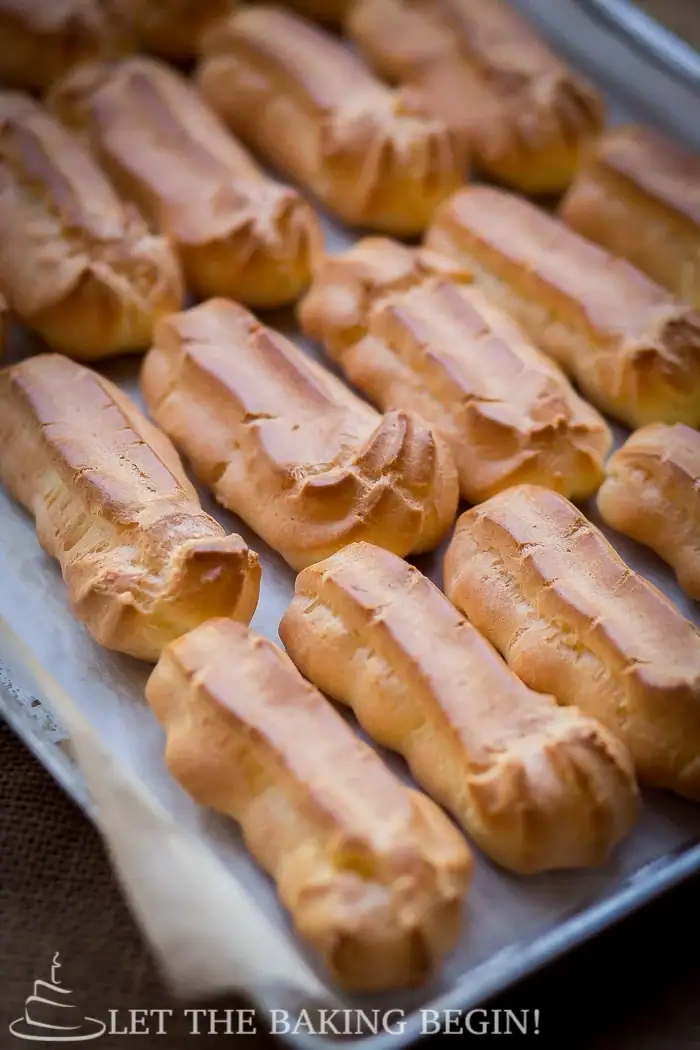
Choux pastry (pate a choux) is the light shell behind eclairs and cream puffs, crisp and golden outside, soft and hollow inside. It’s made in one saucepan, and every step has photos below.
Once you have it down, turn it into my classic eclairs, cream puffs, or maple glazed coffee eclairs.
Why you’ll Love this Choux Pastry Recipe
A few reasons to make choux at home:
- Crisp, light, and hollow – each shell bakes up with a big empty pocket inside, so it holds plenty of cream.
- Just seven ingredients – milk, water, butter, flour, eggs, and a pinch each of sugar and salt. No yeast and no special flour.
- So many ways to use it – pipe logs for eclairs, rounds for cream puffs, or skip the sugar and stir in cheese for gougeres.
- Bake one tray, freeze the other – piped choux keeps in the freezer for up to 1 month and bakes straight from frozen.
What Is Pate a Choux?
Pate a choux (you’ll also see pâte à choux, pate choux, or just choux pastry) is a French pastry dough that’s cooked on the stove before it’s baked. In the oven, the water in the dough turns to steam and puffs each piece up, so it bakes hollow inside.
The name means “cabbages” in French, because round cream puffs look like little heads of cabbage. The same dough makes eclairs, cream puffs, profiteroles, French crullers, and savory gougeres.
The first time I made pate a choux, I was still in high school. I followed a handwritten recipe from my mom’s recipe notebook: a list of ingredients and no real technique. It worked the first time, and then never again. Some batches never rose in the oven, and others puffed up and collapsed as soon as they came out. I kept trying to figure out what made them rise.
Now I’m excited to share every tip I’ve learned, so you know what to look for at each step and your pate a choux puffs every time.
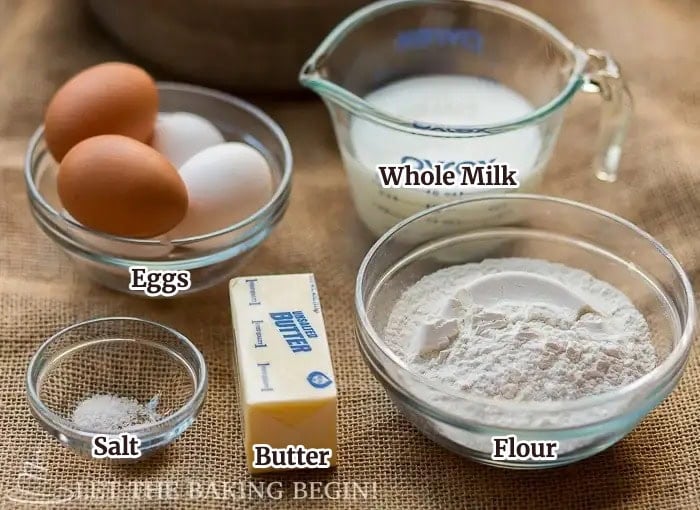
Ingredients for Choux Pastry
Pay the most attention to the eggs and water, because they make the shells puff. Amounts are in the recipe card at the bottom.
Pate a Choux Dough
- Whole milk: its sugars and fat brown the shells deeper and make them a little richer. For a crisper, paler shell, use all water instead.
- Water: it turns to steam in the oven, and the steam puffs each shell and hollows out the middle.
- Unsalted butter: the fat keeps the shell tender and gives it flavor. Salted butter works too; just leave out the salt.
- All-purpose flour: its starch swells in the hot liquid and sets into the walls that hold the puff. Bread flour works too and bakes a slightly sturdier shell.
- Eggs: large eggs. They give the dough the stretch to puff without tearing, and deep orange yolks bake up the most golden shells.
- Granulated sugar: just a pinch, for color and a little flavor. Leave it out for savory gougeres.
- Kosher salt: a small amount keeps the shells from tasting flat. I use Morton.
Tools for Piping Choux
- Pastry bag: a large disposable one, which is easy to fill and toss when you’re done.
- French star tip: a large one with fine, close teeth. A regular star or a large round tip works too.
How to Make Choux Pastry (Step-by-Step)
The dough comes together on the stove in about 10 minutes, and the rest is piping and baking. Every amount and time is in the card at the bottom.
How to Make the Pate a Choux Dough
Have the eggs whisked before you start, because once the flour goes in, things move fast.
- Heat the oven to 425°F and line two baking sheets with parchment.
Lower temp if using dark nonstick pans
Dark pans soak up heat that light aluminum reflects, so the bottoms of the shells brown fast while the insides are still wet. Lower the oven by about 25°F, or stack the dark sheet on top of a second baking sheet. Mine are plain light aluminum.Oven runs hot and cold?
Choux needs a steady heat. Most home ovens run 15 to 25°F off the dial, and gas ovens swing up and down as the burner cycles. Too cool, and the shells spread instead of puffing; too hot, and the tops split. An oven thermometer on the rack shows the real number, so you can adjust the dial before the first tray goes in.
For a gas oven: set the rack one notch below the middle and preheat a baking stone on it for at least 40 minutes, or two baking sheets stacked together. Set the tray of choux right on top. The heavy, hot layer underneath evens out the swings. Keep an eye on the bottoms near the end, since they brown a little faster. - Whisk the eggs in a measuring cup with a spout and set them aside. Whisk just to blend, not foamy; air bubbles can crack the shells. Cold eggs straight from the fridge are fine; they help cool the dough as they go in.
Why whisk the eggs first?
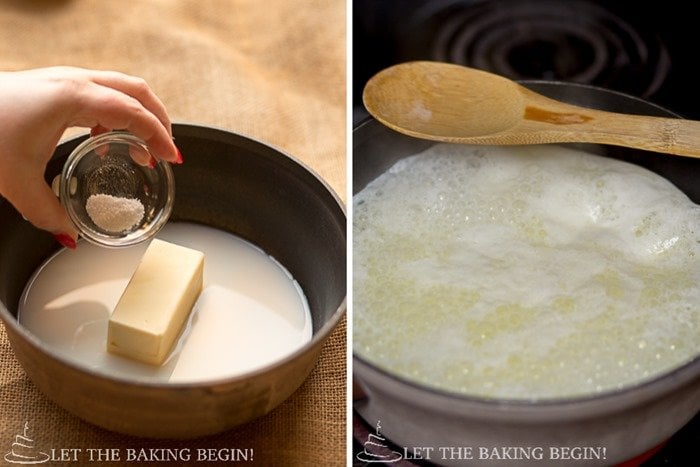
Whisked eggs pour a little at a time, so you can stop the moment the dough looks right. Dropping in whole eggs makes it easy to add one too many. - Boil the liquids: in a stainless steel saucepan, bring the milk, water, butter, sugar, and salt to a boil over high heat. Have the flour measured and ready, and add it the moment the liquid hits a full boil.
Why add the flour right away?
Every minute at a boil steams off water, and that water is what puffs the shells. Let it bubble while you measure the flour and the dough comes out dry, takes less egg than it should, and bakes up small. If the butter isn’t fully melted when the milk starts to boil, pull the pan off the heat and stir until it is, then bring it back up.
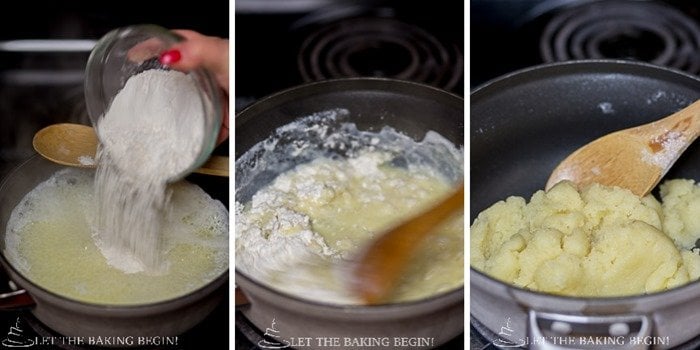
- Add the flour to the boiling liquid all at once and stir fast so it doesn’t lump, then keep stirring over low heat until it looks like thick mashed potatoes and a thin film coats the bottom of the pan. That film only forms on stainless steel, not on nonstick, which is why the pan matters.
What does the hot liquid do to the flour?
Hot liquid makes the starch in the flour soak up water and swell, which thickens it into a smooth paste. Swollen starch holds much more water than raw flour, and in the oven that water turns to steam and puffs the shells. The cooked paste also stretches instead of tearing as the shells rise.My dough looks greasy. Is it ruined?
No. The butter separated because the dough got a little too hot or cooked a little too long. Take it off the heat and move on to the mixer; it pulls back together once the first bit of egg goes in.
- Cool the dough in a stand mixer on low with the paddle, until it feels warm but is no longer steaming, about 125 to 140°F, or cool enough that you can hold your hand on the side of the bowl for 10 seconds.
Why warm and not room temperature?
Hot dough cooks the eggs as they go in, and cooked egg can’t stretch to hold the steam. Egg whites start to set at about 144°F, so once the dough is under 140°F the eggs are safe. But don’t let it cool all the way to room temperature. The starch and butter firm up as the dough cools, and a cold, stiff dough fights the eggs and needs a lot more beating to turn smooth. Warm dough takes the eggs in easily and puffs better in the oven. If you have an instant-read thermometer, aim for 125 to 140°F.No stand mixer?
With a hand mixer: beat the dough in a large bowl on low for a minute or two to cool it, then add the eggs the same way.
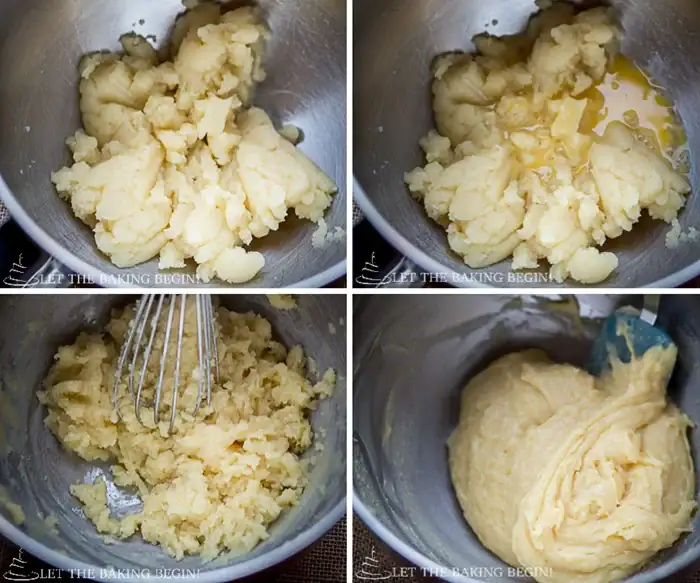
By hand: stir the dough with a wooden spoon until it stops steaming, then beat hard after each egg addition. It looks broken at first and turns smooth as you keep going. - Beat in the eggs a little at a time, until the dough is glossy and falls off the paddle in a thick V. Then mix 30 seconds more so it’s smooth and even.
What does a thick V look like?
Lift the paddle out of the bowl. The dough should hang off it in a thick, glossy V-shaped flap that slowly stretches and drops off after a few seconds. That texture is soft enough to stretch around the steam as it puffs, but firm enough to hold the shape you pipe. If the dough breaks off in a clump or stands in stiff peaks, beat in a little more egg. If it slides off right away in a thin ribbon, it has too much egg.My dough is runny. Can I fix it?
Often, yes. Chill the dough for 30 minutes; it firms up as it cools and may pipe just fine. If it’s still runny, pipe small cream puffs instead of eclairs, and they’ll still taste good. Next time, hold back the last bit of egg and add it a spoonful at a time.
How to Pipe and Bake Choux Pastry
Pipe both trays right away. Then bake them one at a time.
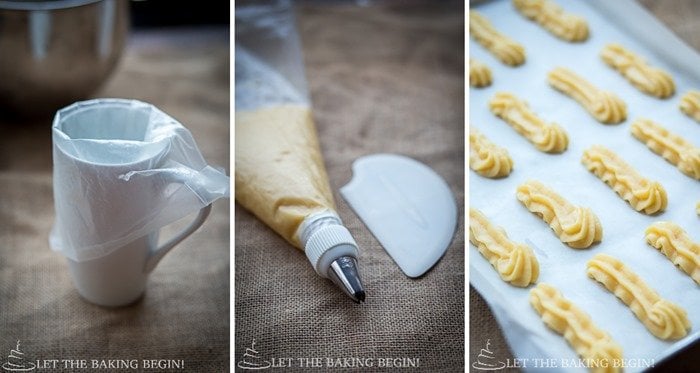
- Fill the pastry bag fitted with a large French star tip, standing it in a tall glass so it’s easy to fill. Push the dough down toward the tip and twist the top closed so no air pockets are left. Trapped air comes out as a gap in the log and bakes into a split side.
What does the star tip do?
A smooth log from a round tip has nowhere to give as it puffs, so the top splits open in random cracks. The ridges from a star tip give the dough lines to expand along, so the eclair rises evenly and bakes round, with neat stripes instead of big splits. A French star has many fine, close teeth, which make lots of shallow ridges. An open star with a few wide teeth leaves deep grooves that can still crack.Don’t have a pastry bag?
Spoon the dough into a zip-top bag and snip off one corner. You’ll get round shells instead of ridged ones, which suits cream puffs. You can also drop mounds of dough with two spoons.Which piping tip for eclairs?
Large French starBestMany fine teeth give lots of shallow ridges, so the dough puffs evenly into a round, even cylinder.Small open starOKA few deep grooves, so the edges bake up a little uneven and lumpy.Round tipRiskiestWorks, but it cracks the most. With no ridges to guide it, the dough splits wherever the crust is weakest.Hold it right: tip 1/2 inch above the sheet at a steady 45° angle. Dragging the tip along the sheet flattens the ridges unevenly, and the eclairs bake a little crooked.
- Pipe the eclairs into 3- to 4-inch logs, about 2 inches apart, keeping the tip about 1/2 inch above the parchment. Hold the bag at a 45° angle and keep the pressure steady; if the tip drags along the sheet, the ridges flatten unevenly and the eclairs bake a little crooked. For straight lines, rest your index finger on the metal tip and your middle finger on the parchment right under it. Glide your middle finger along the sheet as you pipe; it keeps the tip at the same height the whole way. Keep the log the same thickness from end to end, like a steady cylinder. At the end of each log, stop squeezing, then flick the tip back along the top. If an end still sticks up, tap it down with a wet finger.
Why press the tips down with a wet finger?
Piping leaves a little tail of dough where you lift the bag. Dip a finger in water and gently press each one down, so every piece has the same smooth shape. They bake up more uniform, and the tails don’t burn before the rest is done. Raised points are always the first thing to burn.Can I make cream puffs instead?
Yes. Hold the bag straight up with the tip about 1/2 inch above the parchment, and never touching it. Squeeze out 1 1/2-inch mounds without moving the bag, then stop squeezing before you lift away. Press the tips down with a wet finger the same way. Bake at the same temperatures, and start checking at the short end of the time. This batch makes 30 to 40.
- Dust the tops (optional) with a thin, even layer of the powdered sugar mix.
Why dust the tops?
They bake up fine without it. A light dusting gives you a crisper, evenly browned shell and helps the eclairs rise evenly and keep their shape. Mix 1/2 cup (60 g) powdered sugar with 2 teaspoons cornstarch and sift it over the piped dough just before baking. Store-bought powdered sugar already has a little cornstarch; this tops it up so the sugar doesn’t melt into the wet dough before it bakes. - Chill the second tray in the fridge or freezer while the first one bakes.
Can I freeze them and bake later?
Yes. Freeze the piped tray until the pieces are firm, then move them to a freezer bag for up to 1 month. Bake straight from frozen at the same temperatures, with no thawing. For the next day, cover the piped tray and keep it in the fridge up to 24 hours. - Bake the shells at 425°F until they puff to about double their size and the ridges just start to turn light golden, about 15 minutes. Then lower the oven to 375°F and bake until they’re deep golden all over, even in the cracks and creases, and the sides look firm and dry, 10 to 15 minutes more. Keep the oven door closed the whole time; turn on the oven light and watch through the window.
Why two oven temperatures?
At 425°F, the water in the dough turns to steam fast and puffs the shells up high. Lowering the oven to 375°F lets the walls dry out and set around the hollow middle before the outside gets too dark.Something go wrong?
Mine spread flat
The dough was too soft, and that almost always means a little too much egg. This batch won’t puff any more, but flat shells still taste great filled. Next time, stop adding egg once the dough falls off the paddle in a thick V.Mine cracked
A few small cracks are normal, and the filling covers them. Big splits usually mean the dough was a bit stiff, with not quite enough egg, or the oven ran hot. Next time, add egg until you get the thick V, and use an oven thermometer to check the temperature.Soggy inside
They came out a little early, before the walls dried. This batch can be saved: put them back in a 350°F oven for 5 to 10 minutes and they’ll crisp up. Next time, bake until they’re deep golden, even in the creases. - Vent the shells with a skewer right out of the oven. It’s not a must, but it helps. Push it in from both ends and wiggle it around inside to break up any walls, so the filling can run the whole length in one go. Then cool them on a rack.
Why poke holes in them?
The shells are full of steam when they come out. Letting it out right away helps keep the walls from softening as they cool.Want them extra crisp?
After venting, slide the tray back into the turned-off oven and prop the door open with a wooden spoon for 20 to 30 minutes. The leftover heat dries the inside walls, so the shells stay crisp under the filling instead of going soft by the time you serve them. - Bake the second tray straight from the fridge or freezer once the oven is back at 425°F.
Marina’s Pro Tips for theBest Choux Pastry

These help choux bake up tall and hollow.
- Dry the choux dough on the stove. Keep stirring over low heat until a film forms on the pan. Use a stainless steel pot; the film doesn’t form on nonstick, so you lose your cue. A drier dough takes more egg, so the shells puff taller.
- Add the last egg a spoonful at a time. The first additions can go in quickly. Near the end, a little extra egg makes the dough runny, and it can’t be taken back out.
- Pipe eclairs with a French star tip. The fine teeth let the shell expand evenly, so the ridges bake into a round eclair instead of cracking open.
- Make every eclair the same length. Set a guide on the sheet, like a ruler or anything about 4 inches long, and pipe each log right next to it.
- Chill the second tray, don’t leave it on the counter. Piped choux that sits out dries on the surface and puffs unevenly. From the cold, it bakes up just like the first tray.
- Keep the oven door shut until the shells are deep golden. Until the walls set, steam is holding the shells up, and cool air from an open door makes them sink.
- Bake the shells darker than you’d expect. Pale shells look done, but the walls are still soft, and they sink as they cool. Wait until they’re deep golden all over, even in the creases.
What to Make with Choux Pastry
Here’s what I make with one batch of choux.
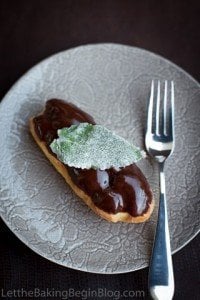
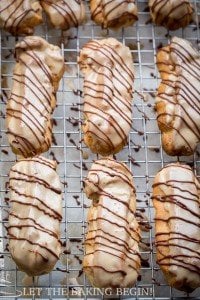
- Eclairs: pipe logs, fill them with custard, and dip the tops in chocolate, like my classic eclairs. The maple-glazed coffee eclairs swap in coffee custard and a maple glaze.
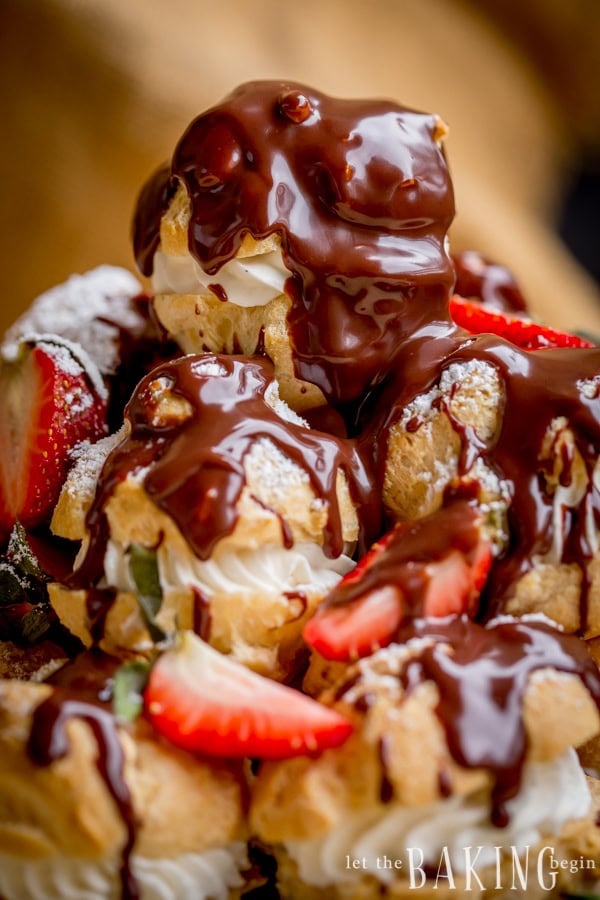
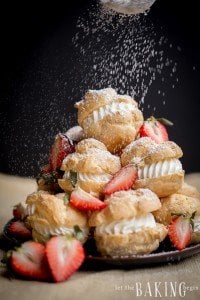
- Cream puffs and profiteroles: pipe small rounds and fill them with sweetened whipped cream, like my cream puffs, or with ice cream for profiteroles.
- Gougeres: leave out the sugar and beat grated Gruyère into the finished dough, about the same weight as the flour. Pipe small rounds for savory cheese puffs. The exact amount is in Note 9 of the recipe card.
- Fillings that hold their shape: pipe my dulce de leche mousseline creme or Nutella custard buttercream right into the shells, and top with extra-glossy chocolate ganache.
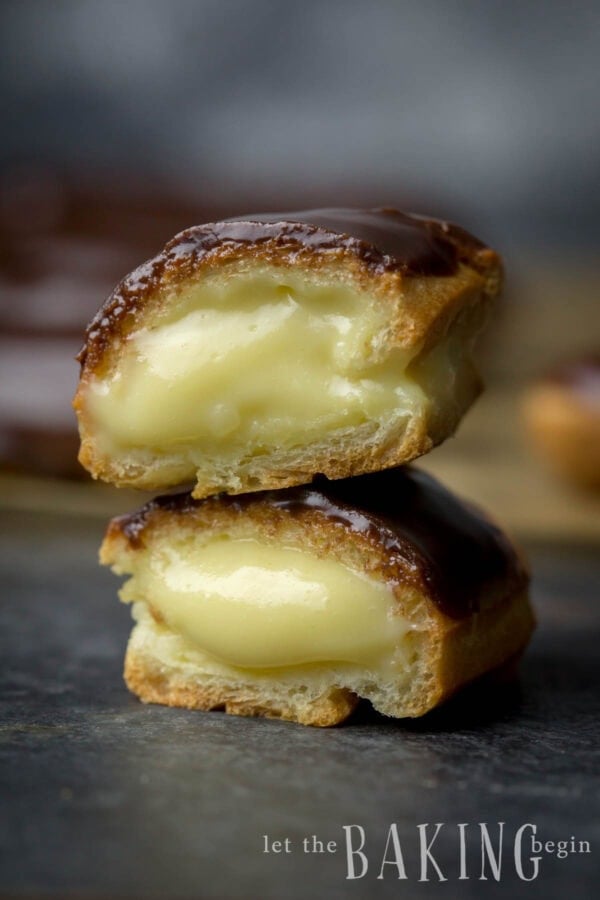
To fill the shells, poke a small round piping tip into the steam holes and squeeze until they feel heavy. For cream puffs, you can also slice off the tops and spoon the filling in.
A perfect eclair has a crisp shell and a creamy filling. For that, fill them no more than 12 hours before serving. Filled earlier, the shells soften a little, which is no big deal, so choose whatever fits your day.
Why did my filled shells go soft?
How to Make Choux Pastry Ahead
Pipe the dough onto a lined tray, freeze it until firm, then move the pieces to a freezer bag for up to 1 month. Bake them straight from frozen at 425°F, the same way the second tray goes in above.
How to Store Choux Pastry
Room temperature: unfilled shells keep for 1 day in an airtight container. Don’t leave filled pastries out longer than 2 hours.
Fridge: filled eclairs and cream puffs keep up to 2 days, covered. The shells soften the longer they sit.
Freezer: baked, unfilled shells keep up to 1 month in a freezer bag.
To reheat: re-crisp shells at 350°F for 5 to 7 minutes, and let them cool before filling.
Quick answers to common choux questions, starting with the one that goes wrong most often.
Choux Pastry FAQ
Why Did My Choux Pastry Collapse?
Most of the time, the shells came out of the oven too early. Steam holds them up while they bake, and if the walls haven’t dried and set, they sink as they cool. Opening the oven door before they’re golden does the same thing. Bake until they’re deep golden all over, and vent them right away.
Are Eclairs and Cream Puffs Made with the Same Dough?
Yes. Eclairs, cream puffs, and profiteroles all start with this pate a choux. Eclairs are piped into logs and cream puffs into rounds, and profiteroles are small cream puffs, usually filled with ice cream.
What’s the Difference Between Choux Pastry and Puff Pastry?
Choux pastry is a soft dough cooked in a saucepan, and it rises from steam trapped inside by the eggs. Puff pastry is a rolled dough folded around layers of butter, so it bakes into flaky sheets. If that’s the one you’re after, try my quick puff pastry.
How Do You Pronounce Pate a Choux?
Say it like “paht ah SHOO.” Choux rhymes with shoe, which is why you’ll also see it spelled shoe pastry.
More Choux Pastry Recipes to Try
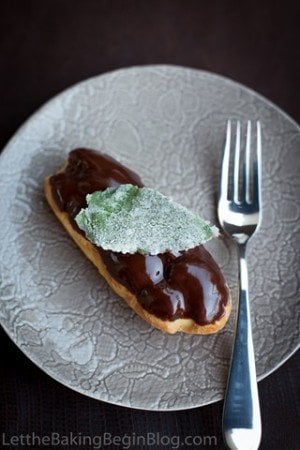
Classic Eclairs
These same shells, filled with creamy custard and dipped in a shiny chocolate glaze.
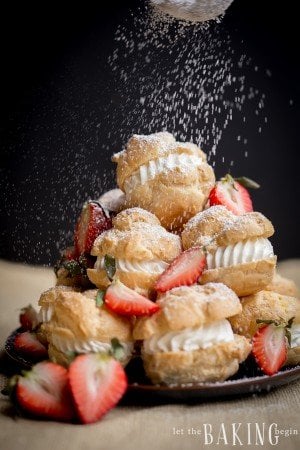
Cream Puffs
Little round puffs filled with lightly sweetened vanilla whipped cream.
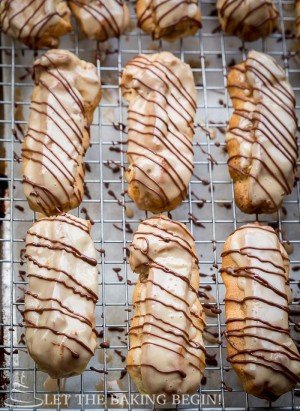
Maple Glazed Coffee Eclairs
Coffee custard inside and a maple glaze on top, like the ones from a French patisserie.
Choux Pastry Buttermilk Crepes
Thin buttermilk crepes, great with fresh strawberries.
Made this choux pastry?
Please leave a ⭐⭐⭐⭐⭐ star rating and a comment below.
It helps other readers find the recipe, and I love seeing what you filled yours with.
Choux Pastry Recipe (Pate a Choux)

Choux pastry (pate a choux) is the light shell behind eclairs and cream puffs, crisp and golden outside, soft and hollow inside.
Before you start: the tricky parts are drying the dough, adding just enough egg, and piping. The post above walks through each one with photos, the why behind every step, and fixes if something goes wrong.
Ingredients
Pate a Choux Dough
- 1/2 cup (120 ml) whole milk
- 1/2 cup (120 ml) water
- 1/2 cup (113 g) unsalted butter
- 1/4 tsp granulated sugar
- 1/4 tsp kosher salt Morton
- 1 cup (150 g) all-purpose flour
- 5 (250 g) large eggs whisked; you may not need all of it
Tools for Piping Choux
- 1 pastry bag large
- 1 French star tip large, such as Ateco 869
- 2 baking sheet Light aluminum, lined with parchment. Dark nonstick, see Note 1.
- Saucepan Medium, stainless steel (not nonstick)
- Stand mixer or hand mixer Or a wooden spoon, see Note 7.
- Piping bag 18-inch, disposable or reusable
- Large French star piping tip Like Ateco 869; gives the most even eclairs
Instructions
How to Make the Pate a Choux Dough
-
Heat the oven to 425°F and line 2 baking sheets with parchment paper. An oven thermometer on the middle rack shows the real temperature. Dark nonstick sheets? See Note 1.
-
Whisk the eggs: in a measuring cup with a spout, whisk 5 large eggs just until blended, not foamy, and set them aside.
-
Boil the liquids: in a medium stainless steel saucepan (not nonstick), bring 1/2 cup whole milk, 1/2 cup water, 1/2 cup unsalted butter, 1/4 tsp granulated sugar, and 1/4 tsp kosher salt to a full, rolling boil over high heat, with the butter fully melted. Add the flour the moment it boils.
-
Add the flour: to the boiling liquid, add 1 cup all-purpose flour all at once and stir fast with a wooden spoon until it pulls into a ball. Turn the heat to low and keep stirring for 2 to 3 minutes, until it looks like thick mashed potatoes and a thin film coats the bottom of the pan.
-
Cool the dough: move it to the bowl of a stand mixer and mix on low with the paddle for 2 to 3 minutes, until it feels warm but is no longer steaming, about 125 to 140°F, or cool enough to hold your hand on the bowl for 10 seconds. Do not cool it to room temperature (see post above for why). No stand mixer? See Note 7.
-
Beat in the eggs: with the mixer on low, add the whisked eggs to the dough in 4 to 5 additions, mixing until smooth before each one. Each addition looks slippery and broken at first, then comes back together. Stop when the dough is glossy and falls off the paddle in a thick V, even if some egg is left (Note 2). Then mix 30 seconds more until smooth.
How to Pipe and Bake Choux Pastry
-
Fill the pastry bag: fit 1 pastry bag with 1 French star tip, stand it in a tall glass, and fill it with the dough. Push the dough down to the tip and twist the top closed so there are no air pockets.
-
Pipe the eclairs: onto the lined sheets, pipe 3- to 4-inch logs about 2 inches apart, the same thickness from end to end, holding the bag at a 45° angle with your index finger on the metal tip and your middle finger gliding on the parchment as a guide, and the tip about 1/2 inch above the parchment. Stop squeezing at the end of each log and flick the tip back, then tap down any ends that stick up with a wet finger. For cream puffs, see Note 3. Optional: dust the tops with powdered sugar (Note 10).
-
Chill the second tray in the fridge or freezer while the first one bakes (Note 4).
-
Bake the shells: at 425°F until puffed to about double and the ridges are just turning light golden, about 15 minutes. Lower the oven to 375°F and bake 10 to 15 minutes more, until deep golden even in the creases and the sides look firm and dry. Keep the oven door closed until they are golden, or they will deflate. Soggy inside? See Note 8.
-
Vent the shells (optional, but it helps): right out of the oven, poke 2 holes at each end of every shell with a skewer to let the steam out, and wiggle the skewer inside to break up any inner walls, then cool them on a wire rack (Note 5).
-
Bake the second tray straight from the fridge or freezer once the oven is back at 425°F, with the same times and temperatures.
Recipe Notes
1. Dark baking sheets: a dark nonstick sheet runs hotter than light aluminum and can brown the bottoms before the shells dry out inside. Drop the oven about 25°F, or stack it on a second sheet.
2. How much egg: the dough is ready when it is glossy and slides off the paddle slowly, leaving a thick V-shaped ribbon hanging. Stop there, even with egg left over. Too much egg makes the shells spread flat, and it cannot be taken back out.
3. Cream puffs: hold the bag straight up, tip about 1/2 inch above the parchment, and pipe 1 1/2-inch mounds about 2 inches apart and smooth the tips with a wet finger. Bake at the same temperatures and start checking at the short end of the time. The batch makes 30 to 40.
4. Freeze unbaked: freeze the piped tray until firm, then move the pieces to a freezer bag for up to 1 month. Bake straight from frozen at 425°F as written.
5. Baked shells: keep unfilled shells airtight at room temperature for 1 day, or freeze them for up to 1 month. Recrisp at 350°F for 5 to 7 minutes and cool before filling.
6. Filling: fill the shells no more than a few hours before serving, and keep filled pastries in the fridge.
7. No stand mixer: with a hand mixer, beat the dough in a large bowl on low for a minute or two to cool it, then add the eggs the same way. By hand, stir with a wooden spoon until it stops steaming, then beat hard after each addition of egg. It looks broken at first and turns smooth as you keep going.
8. Soggy shells: put them back in a 350°F oven for 5 to 10 minutes to dry out, then vent and cool again. Next time, bake until they are deep golden, even in the creases.
9. Gougeres: leave out the sugar. After the last egg, beat in 1 1/2 cups (150 g) finely grated Gruyere, about the same weight as the flour. Pipe 1-inch rounds and bake at the same temperatures, checking at the short end of the time.
10. Powdered sugar dusting (optional): mix 1/2 cup (60 g) powdered sugar with 2 teaspoons cornstarch and sift a thin layer over the piped dough before baking. It gives a crisper, evenly browned shell.
Thank you for following me on Instagram, Facebook & Pinterest!
Hashtag your photos #LetTheBakingBeginBlog so I can see your creations and for a chance to be featured!
This pate a choux recipe has been on the blog since 2015, and it’s the base for my eclairs and cream puffs. For this September 2026 update, I added tips at each step, a fix-it guide for flat, cracked, or soggy shells, freezing and make-ahead notes, and metric measurements in the recipe card.
Marina | Let the Baking Begin










Hello Marina,
Can these be frozen after made? I’ve purchased from our local bakery and sometimes they seem like they’ve been frozen. I’m baking a variety of pastry for an event and freezing would save me time. Thanks for sharing your recipe and tips. I’m anxious to make them!
Hello Louise,
Yes, these can be frozen. Good luck in your baking!
Hi Marina!
Wanted to give you my token of appreciation for posting this recipe. I finally got around to making good it. I made everything according to the recipe directions, however piped them out round.They baked evenly and came out perfect. Not a single one got deflated, which is the case sometimes with заварным тестом.
Awesome recipe, great work.
Blessings!
The recipe really works! Did some savory eclairs with dill and turkey paste and some for dessert with chocolate mousse with peanut butter. Incredible. Thanks!
Oh wow! dill and turkey paste? tell me more! that sounds like a great combination! I’m glad you liked this recipe!
I am absolutely trying this! Question though, once first sheet is done backing, am I just throwing the frozen one right into the Owen from freezer?
Yeap, just put it in the oven straight from the freezer 🙂
Cant wait to make this. Thank you for recipe.
You’re welcome, thank you for reading my blog!
Yum! I admit I’ve never made choux pastry, but I might have to try this tried and tested recipe!
You might have to Katy, it’s a good recipe and eclairs are pretty delicious 😉
Hi Marina!
Thank you for the tip. I had the same problem where these get really picky and won’t came out properly.
May I ask what brand of butter you are using? Also, would you be so kind as to share what kind of flour works best.
Thank you so much.
Hope your daughter is better.
Blessings! !
Hi Lena!
After that first bad recipe that wouldn’t come out I have been using this recipe and every time I would be afraid that for some reason it wouldn’t work, but fortunately it has worked every time. So if you follow the instructions I think you will get the same results 🙂
I use the Costco unsalted butter and Canadian all purpose flour. I only buy Canadian for my all-purpose flour needs. No better flour than that 🙂 And Costco has the best price for the quality so I only get theirs.
My daughter is feeling better, finally…